The how-to guide · Second edition, 2026
Starting with Strengths
An asset-based lens on Community-Oriented Primary Care, for the primary health care teams, community health workers, Area Based Teams and partners who will run the work. It sets out the method in enough detail to plan it, budget for it and account for it.
Published by the Western Cape Department of Health and Wellness · Service Reform Project & ABCD Task Team · Licensed CC BY-NC-SA 4.0
Contents
2 · COPC in a nutshell
3 · ABCD in a nutshell
4 · How they fit, and where they do not
5 · The Asset Mapping Framework
How to read this guide: Sections 2 to 4 give you the ideas (about 20 minutes). Sections 5 to 9 give you the practice. If you only have time for one, read Section 9: what to do after the map.
1 · Why this work, and whose it is
If you work in or with a primary health care (PHC) team in the Western Cape, you have probably heard two phrases with growing frequency: Community-Oriented Primary Care (COPC) and Asset-Based Community Development (ABCD). You may also have heard that teams are expected to do asset mapping, and wondered what exactly that involves, and, more importantly, what happens once the map is made.
This guide answers those questions in plain language. It explains what COPC and ABCD each are, how they fit together and where they pull in different directions, and then walks step by step through asset mapping: preparing for it, doing it, putting assets on a shared map, and, the part most often missed, mobilising the assets you have found so that the map changes what happens in your community rather than gathering dust in a file.
Who this guide is for
It is written for the people who will run the work: PHC teams, community health workers, Area Based Team members, sub-district managers, and the partners and non-profit organisations who work alongside them. Community members are the other audience, served by a companion set of materials derived from this guide: short handouts in isiXhosa, Afrikaans and English, workshop cards, posters and brief videos. Plain language is the rule throughout.
What problem are we solving?
It is a fair question, and it usually comes early in a community meeting: what is wrong here that this is meant to fix? Starting with strengths is not a claim that nothing is wrong. It is a claim about how problems get addressed and by whom. The community diagnosis still records need in full. There are two honest answers, and a team should know which one applies.
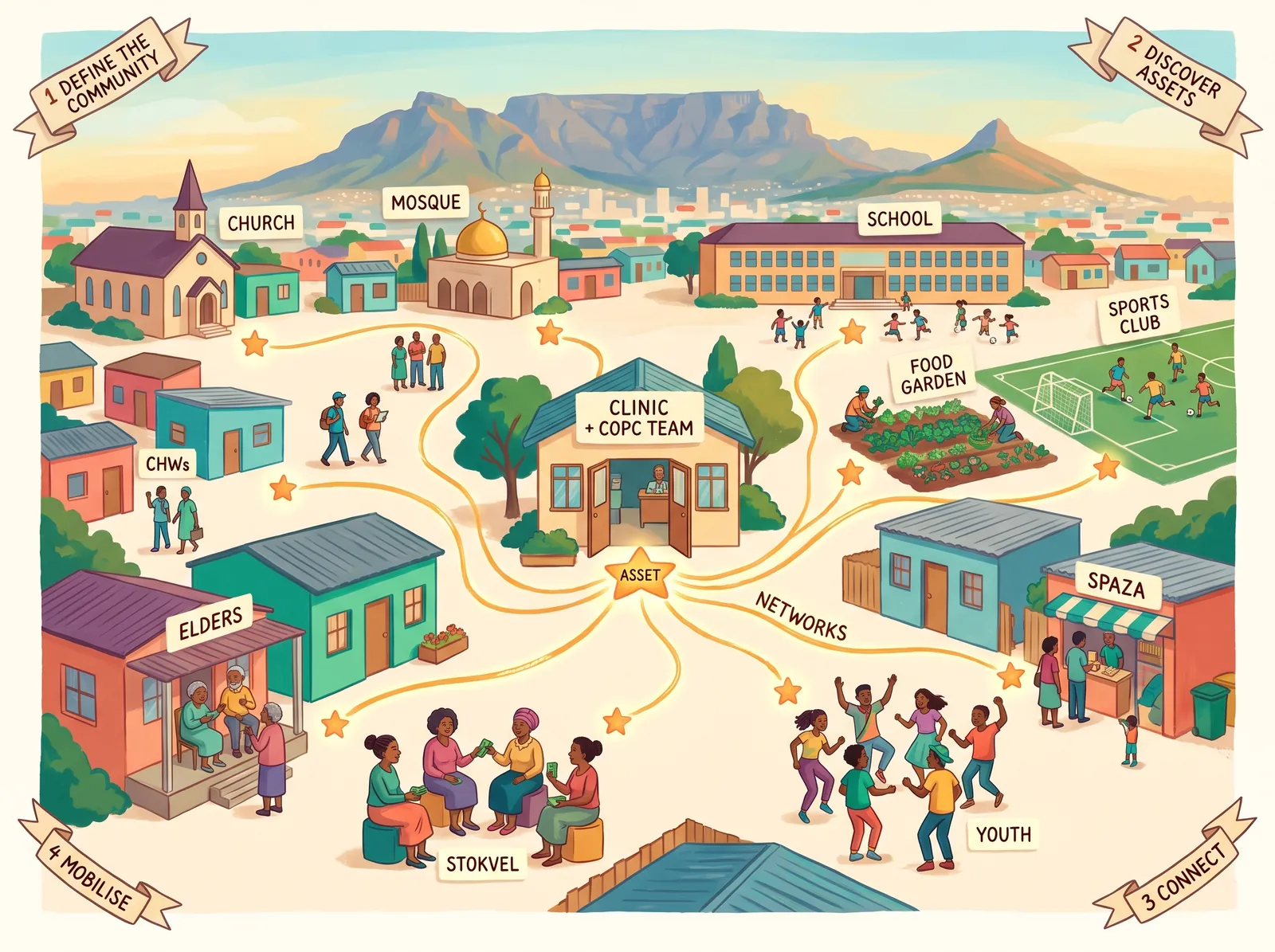
A problem the community has already named. Most of the time there is a priority on the table: uncontrolled diabetes, teenage pregnancy, children missing immunisations, an outbreak, people not returning for treatment. The asset lens does not replace that priority. It asks a second question of it. Not only what service must respond, but who here already does something about this, and what would help them do more? A node with poor diabetes control has a clinic with a waiting list. It also has a church that already walks together on a Wednesday morning, a woman who cooks for four households on the same street, and a young man who coaches soccer three afternoons a week. A response designed with those three looks different, and it costs less.
Nothing in particular is wrong today. The second answer is harder to say out loud and matters more. A community where nothing is currently in crisis is the best possible place to do this work, because the shocks that are coming are not a matter of if but of when: an outbreak, a fire, a flood, a drought, weeks without water or electricity, a factory closing. What determines how a place comes through a shock is only partly the size of the emergency response. It is also who knew whom beforehand: who has the list, who has the key to the hall, who will check on the man at number 14, which WhatsApp group actually reaches people. Social infrastructure, rather than physical infrastructure, is what most reliably predicts survival and recovery, and it is built before the event, not during it.
If someone asks what this is for, the answer is short. It is to find out what this community can already do, so that whatever comes next builds on that instead of ignoring it. And so that when something does go wrong — a fire, a flood, an outbreak, a week without water — we are not starting from strangers.
Whose work this is
This guide is published by the Department of Health and Wellness, which makes it easy to read as a programme the Department intends to run. It is not, and it could not be. The Department sits at the centre; it cannot listen to every community, and holding what these conversations produce moves a community's knowledge of itself to the place where it is least useful and ages fastest. The position of this guide is therefore:
- The work belongs to the community and to whoever already convenes there. In most nodes somebody is already doing a version of this without calling it asset mapping. The task is to find them, not to replace them.
- The community holds its own record. The asset register, the stories and the timeline live where the community keeps them. What enters departmental systems is only what has been shared by agreement, and it is a copy. The master stays with the community.
- Health teams take part; they do not preside. A PHC team, a CHW or an ABT member is a participant, a co-mapper, and itself one of the assets in the community's account of itself.
- The Department's job is to make this possible, not to make it happen. Provide the method, materials, training and platform. Resist the instinct to convene, standardise, set targets, select sites and report coverage.
- Promise nothing that is not already funded. A meeting called by government carries an implicit promise of resources. An unmet expectation costs more trust than the exercise was ever going to build.
- A community that does not want to do this has given an answer, not a failure. There is no coverage target here, and no node is behind.
Ask two questions. Would this conversation be happening if we were not here? Will it continue after we leave? If the answer to both is no, this is not a community's process; it is a departmental exercise with community members in it, and it will stop when the funding or the enthusiasm does.
2 · COPC in a nutshell
A South African idea that travelled the world. COPC is not an import. It was pioneered in the 1940s by Sidney and Emily Kark and their colleagues at the Pholela Health Centre in what is now KwaZulu-Natal, where curative care was integrated with community health work for a defined population. The Pholela innovations are widely regarded as foundational to global primary health care and to the thinking behind the Alma-Ata Declaration. Bringing COPC into Western Cape practice therefore brings an idea home.
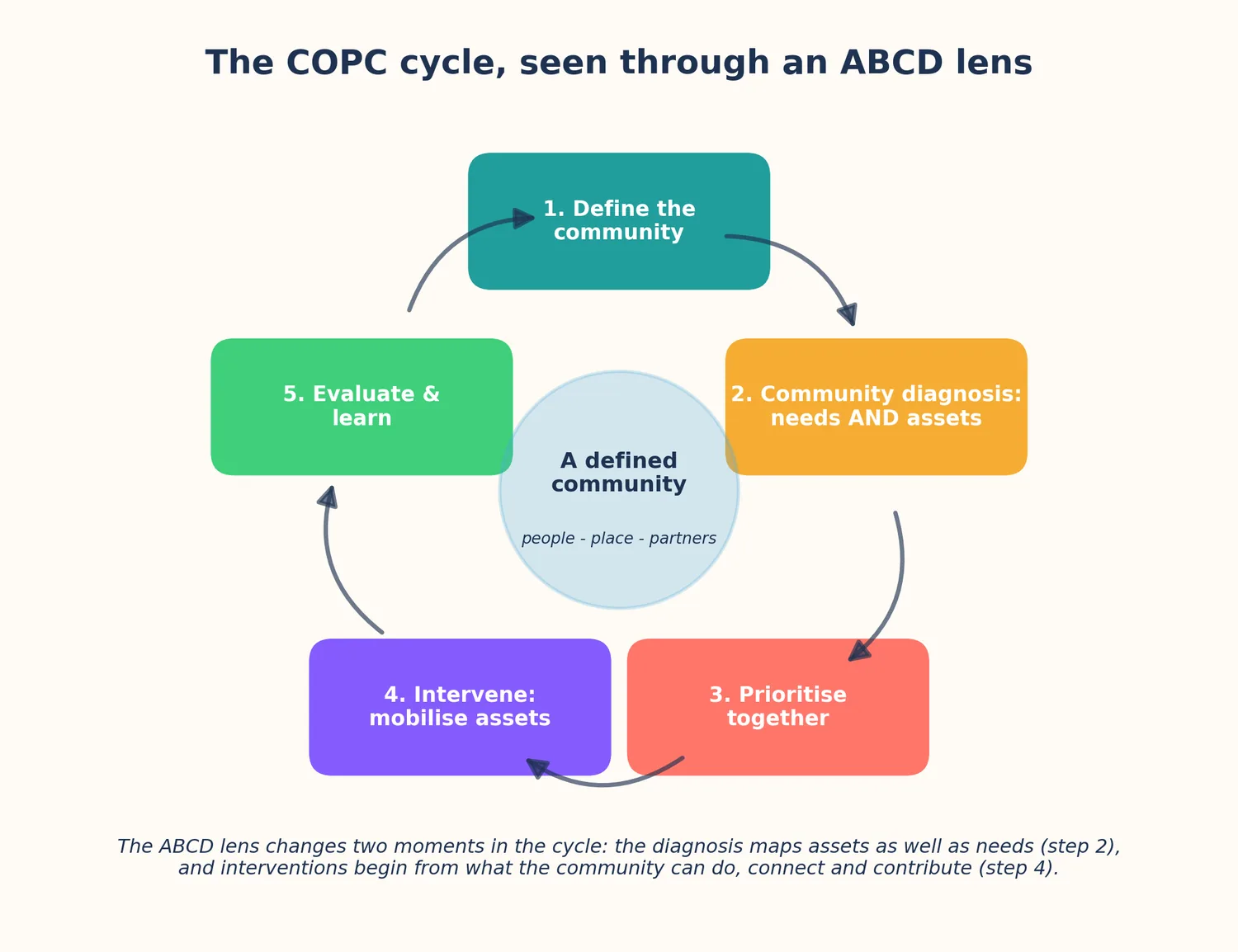
What COPC is. A continuous process by which primary care is provided to a defined community on the basis of its assessed health needs, through the planned integration of public health practice with the delivery of primary care services. Three words carry the weight: Defined — the team serves a named geographic community, a node, with a known population, not whoever walks through the door. Continuous — the work follows a repeating cycle rather than a once-off project. Integration — clinical care and population health are done by the same team, in the same place, as one practice.
3 · ABCD in a nutshell
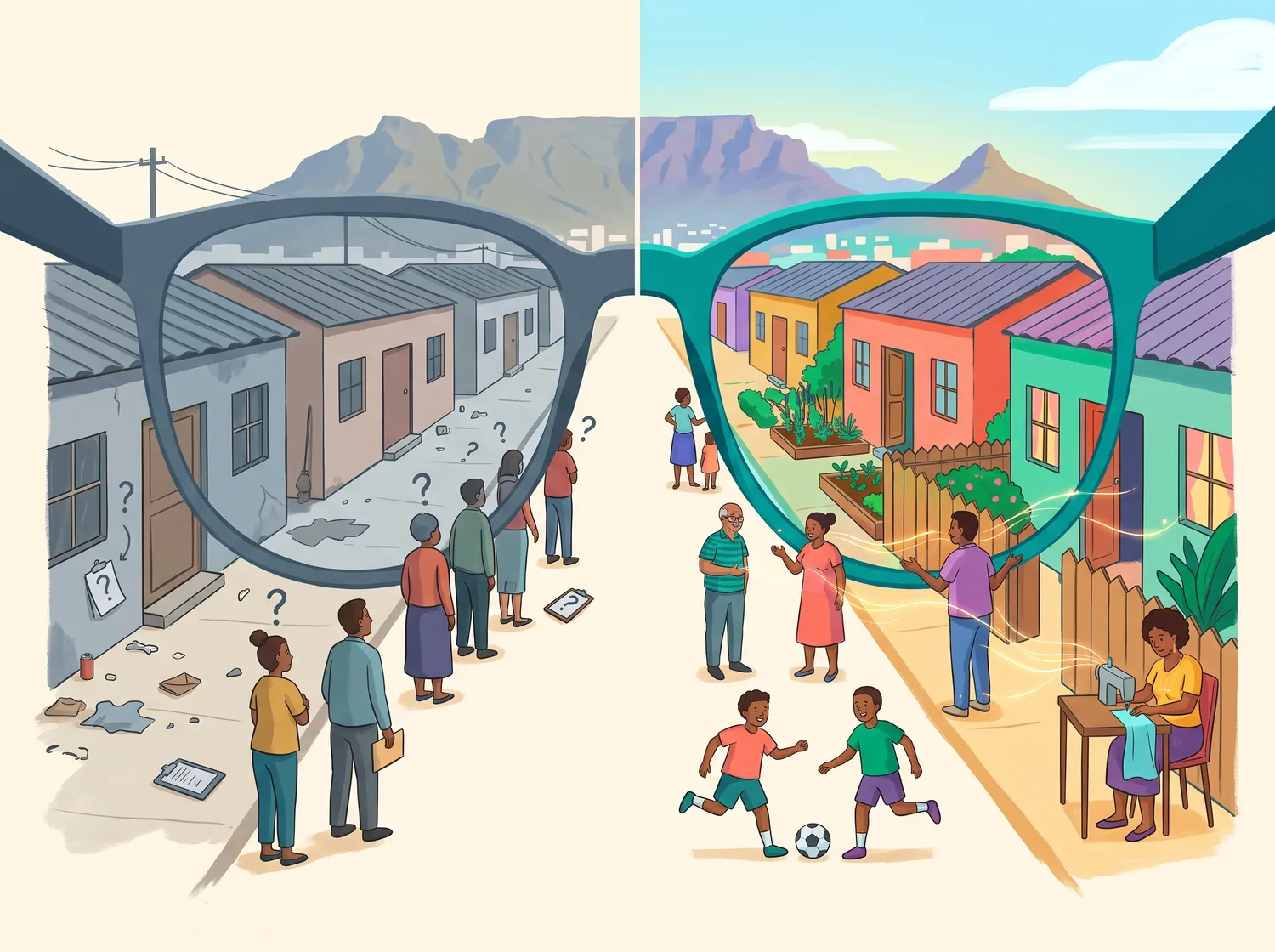
The glass half-full. ABCD was articulated by John Kretzmann and John McKnight, whose 1993 book Building Communities from the Inside Out drew on fieldwork in over 300 low-income neighbourhoods across the United States. Their starting point was a critique: strong professionalised service systems can weaken communities by recasting citizens as clients, consumers of services defined by their deficiencies. A community that is only ever surveyed for its problems learns to describe itself by its problems.
ABCD proposes the opposite starting point. Begin with what is present rather than what is absent: the gifts, skills and capacities of residents; the power of local associations; the resources of local institutions; the land, buildings and economy of the place; and its culture and stories. This is often summarised as seeing the community as a glass half-full rather than half-empty. In health, the same intuition has its own lineage: Antonovsky's salutogenesis asks what keeps people well rather than what makes them sick.
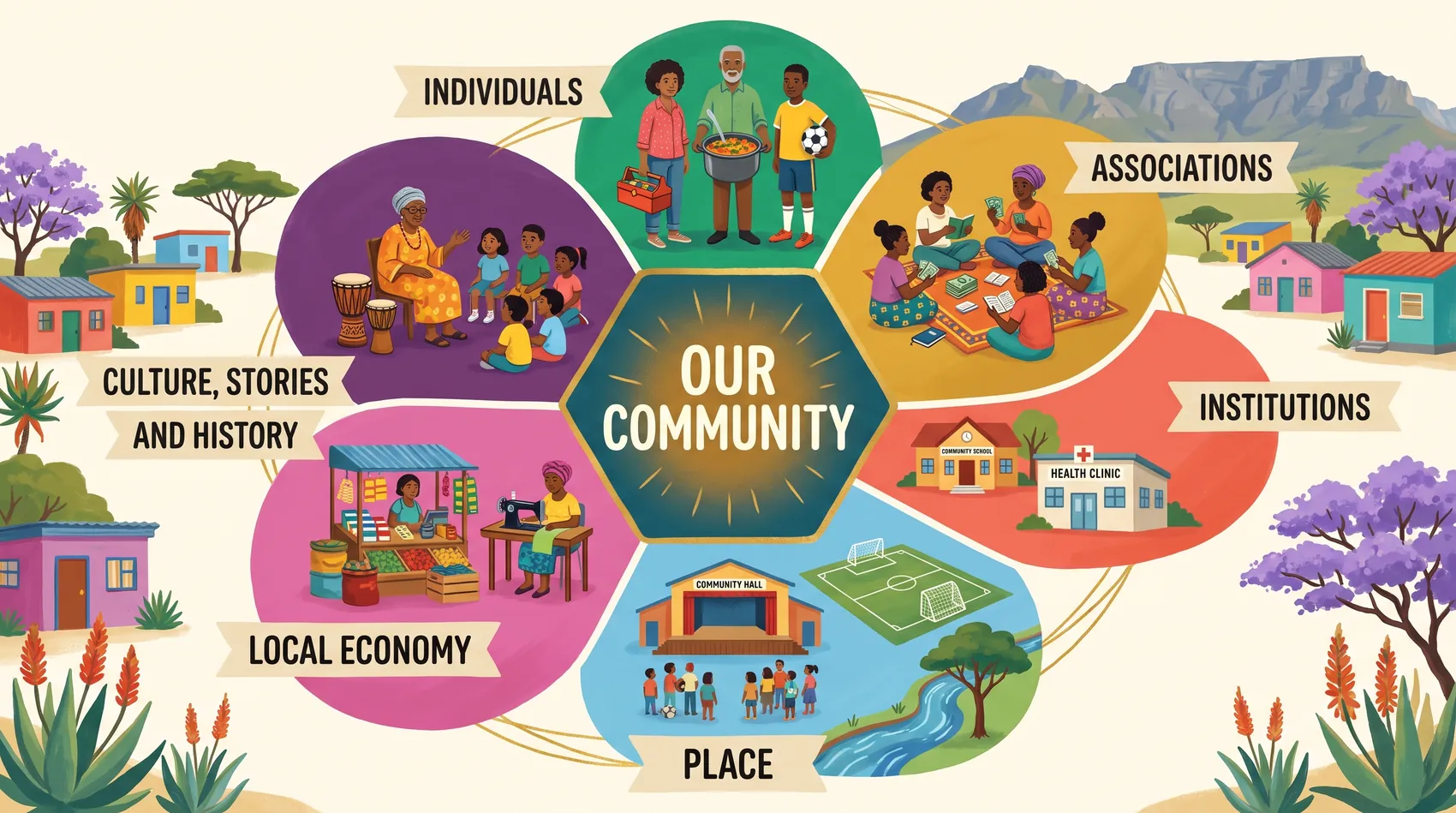
Later ABCD writing sets the raw material out as six kinds of community resource: the gifts of individuals, the power of associations, the resources of institutions, the physical assets of place, the local exchange of money and labour, and the community's stories. Stories are not decoration around the asset list. They are one of the assets, and the medium through which most of the others become visible.
Four commitments
Four commitments distinguish ABCD from conventional needs-based practice:
- Asset-based, not deficit-based. Start from gifts and capacities, then address problems from that base of strength.
- Internally focused. Prioritise the agency of residents and local associations; draw in external resources second, not first.
- Relationship-driven. Treat the connecting of people to one another as the engine of change, not an administrative afterthought.
- Citizen-led. Residents are producers of their own development, not recipients of services.
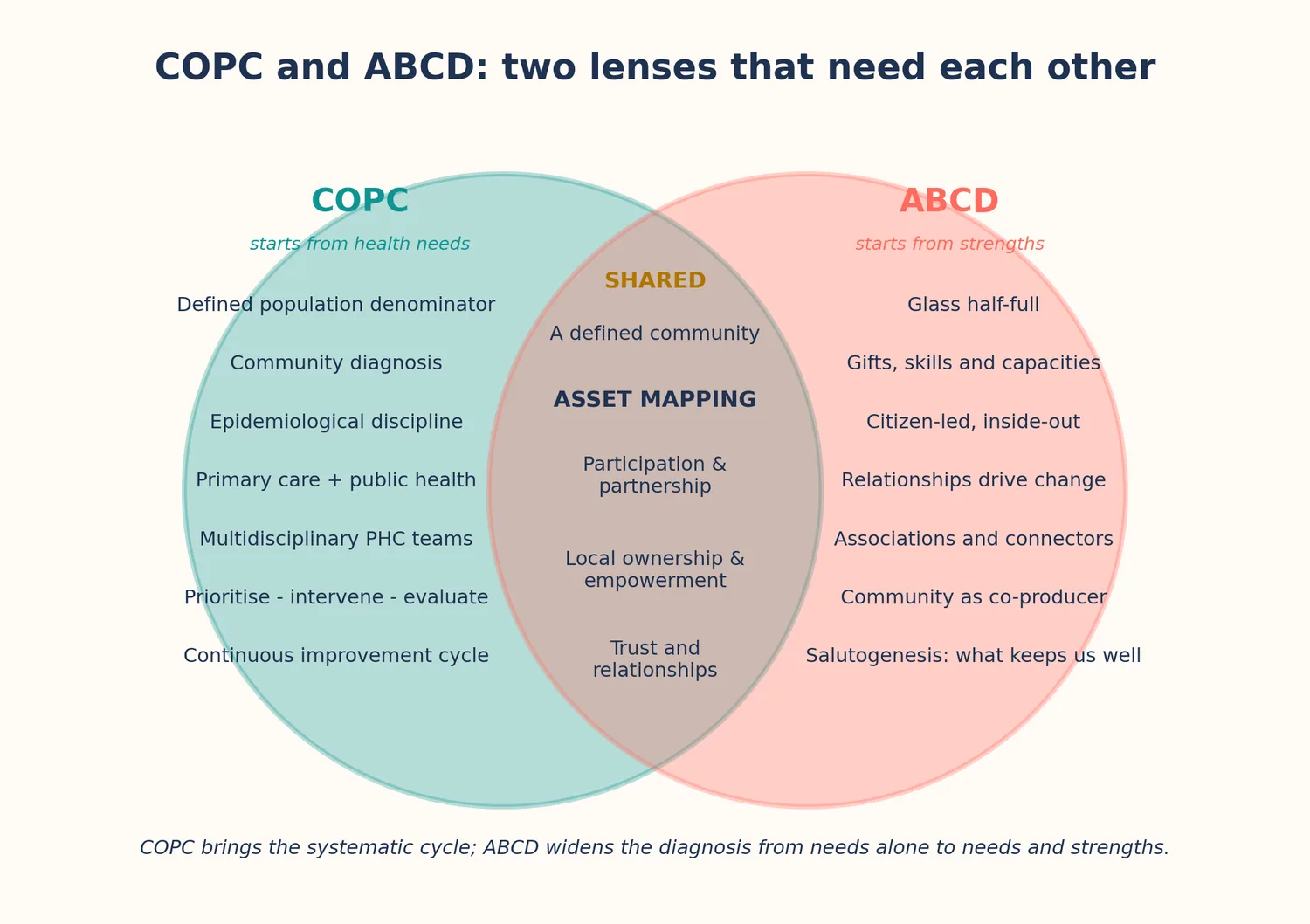
COPC: defined population, community diagnosis, epidemiological discipline, prioritise, intervene, evaluate. ABCD: gifts, associations, connectors, citizen-led, inside-out, glass half-full. Shared: a defined community, participation, partnership, local ownership, trust, and asset mapping.
4 · How COPC and ABCD fit together, and where they do not
Natural partners. The two approaches share three defining features. Both work with a defined community rather than an undifferentiated public. Both treat community participation as constitutive of good practice rather than an optional extra. And both aim at empowerment and local ownership. COPC contributes what ABCD lacks: a systematic, repeating epidemiological cycle and the integration of clinical care with population health. ABCD contributes what COPC has historically underplayed: a strengths orientation and a practical mapping methodology.
This is not a theoretical marriage. South Africa's PHC re-engineering operationalised COPC through ward-based outreach and health-post teams in Tshwane, and the Metro Health Services framework for implementing COPC in Cape Town is explicitly based on asset-based thinking, pairing CHW-led household assessment with community engagement to co-define available health resources and needs.
Where they pull apart. The fit is good but not seamless. COPC's community diagnosis is oriented toward unmet need and the social determinants of health. ABCD reacts against deficit framing and can, in some formulations, understate material disadvantage. Critics have warned that an asset discourse can be used to legitimise the withdrawal of services, shifting responsibility onto communities: neoliberalism with a community face. The working position of this guide is that the two are complementary diagnostics. The asset lens widens the community diagnosis; it does not replace the epidemiological assessment of need, and it never becomes an argument for the state to do less. Map assets and needs. Mobilise strengths and advocate for resources. It is both, always.
5 · The Asset Mapping Framework
This section presents the Asset Mapping Framework developed within the ABCD Task Team. It establishes the principles, processes and governance for systematically identifying, cataloguing and integrating community assets in support of COPC-based PHC delivery across the Western Cape.
Six guiding principles
- Asset-based thinking. Identify what exists, what works and who contributes, creating pathways that welcome assets into service and volunteering.
- Expanding discovery. Mapping must continuously expand beyond familiar categories toward informal networks, faith communities, cooperatives, schools, sporting bodies and cultural institutions. Each cycle should identify at least one new category of asset not previously recorded for that catchment.
- Volumetric measurement. Asset mapping is a measurement exercise, not merely a cataloguing one. Each asset is characterised by scale and reach: people reached per month, frequency, geographic coverage, and capacity for expanded engagement.
- Integration into the formal PHC network. Asset registers are living documents maintained by PHC facilities and shared upward to inform the community health assessment.
- Equity and inclusion. Mapping must actively include assets serving marginalised and vulnerable groups — farm workers, informal settlement residents, persons with disabilities. Equity considerations are recorded for each asset.
- Community participation. Communities are partners, not subjects. Members, forums, ward committees and CHW networks are co-mappers and validators.
Three levels of assets
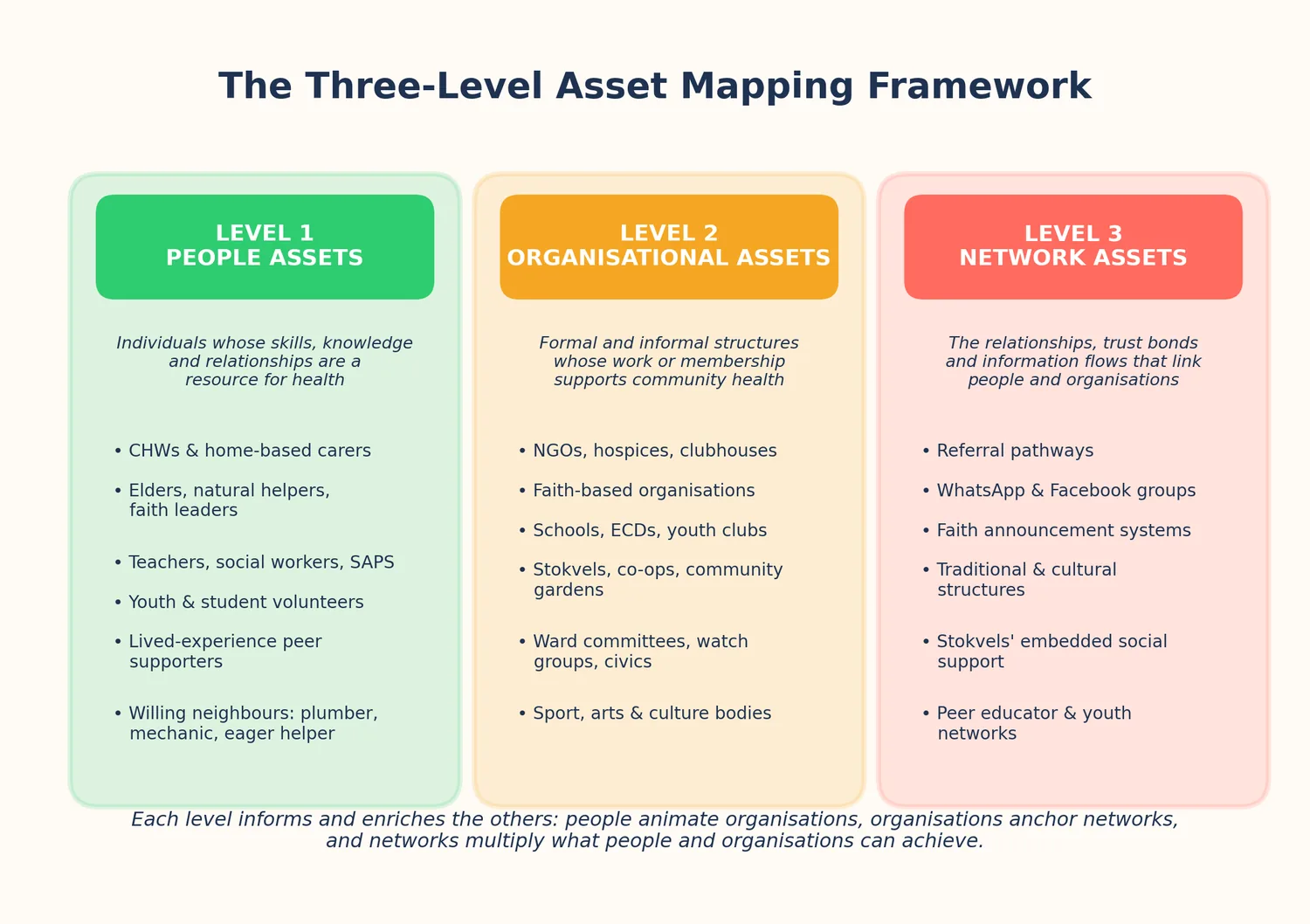
The framework maps community assets at three levels, each informing the others. Each level plugs into, and draws its power from, the same shared source: the community itself.
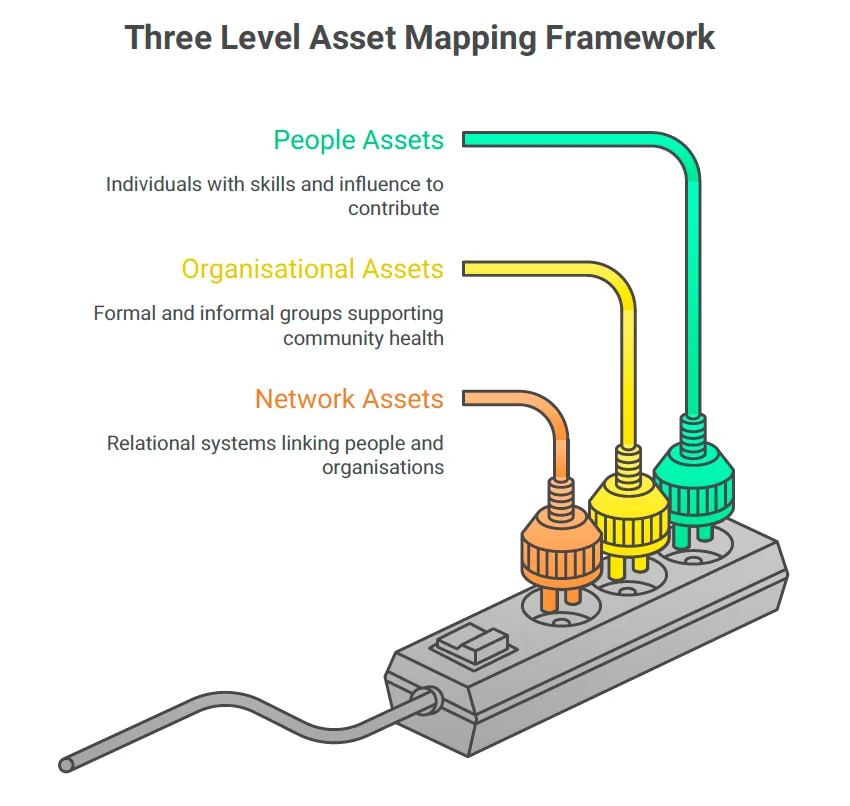
In a single block in a small Karoo town: at Level 1, Mrs September, who has collected medicines for four housebound neighbours every month for eleven years. At Level 2, the church across the road, whose hall stands empty every weekday morning. At Level 3, the WhatsApp group of eighty households through which news of a death travels faster than any circular. A needs assessment records unemployment, distance and a shortage of transport. An asset map records Mrs September, the hall and the group, and a plan begins to suggest itself before a single new resource is requested.
Level 1 · People assets. Individuals whose skills, knowledge, experience, relationships or influence are a resource for health: the formal workforce (CHWs, home-based carers); natural helpers, respected elders and faith leaders; local expertise (teachers, social workers); youth and student resources; people with lived experience who can serve as peer supporters; and willing neighbours with no health background at all. The classic instrument here is the capacity inventory, which records residents' gifts of the head, hands and heart.
Level 2 · Organisational assets. Formal and informal structures, from registered non-profits to a neighbourhood watch: health and welfare NGOs; faith-based organisations; schools and ECD programmes; economic structures such as stokvels, cooperatives and community gardens; civic structures such as ward committees; non-health government services; emergency and safety groups; and arts, culture and sport bodies.
Level 3 · Network assets. The relational systems, coalitions and webs of connection that link people and organisations. Not formal entities, but the relationships, information flows and trust bonds that multiply the impact of everything else. Finding them means asking: who refers to whom, who trusts whom, where do people actually seek information? Level 3 is where the ABCD literature says the real energy lies: relationships are the engine of change.
A directory of organisations is the easy third of the job. The people level catches gifts that no organisation owns; the network level catches the connective tissue that makes assets usable. A community with many organisations but weak networks behaves very differently from one with few organisations and dense trust. Mapping all three is what turns a list into an understanding.
Six categories to look for, three levels to file them under
The three levels say where an asset sits in the social order of a place. The wider ABCD literature uses six categories, which answer a different question: not where an asset sits, but what kind of thing it is. Use the six categories when you are looking, and the three levels when you are recording.
- Individuals. The gifts, skills, knowledge and passions of residents.
- Associations. Informal, volunteer-driven groups — burial societies, savings clubs, neighbourhood watches, church groups, soccer leagues. ABCD treats these as the primary engine of community action because they run on relationships rather than authority.
- Institutions. Formal organisations with staff, budgets and premises. Their usable assets are often the hall, the printer, the bakkie and the expertise, not the programme.
- Place. The built and natural environment: halls, empty buildings, fields, land, rivers, open ground, shade.
- The local economy. Spending power, savings, cottage industry, local trade, and what a place produces or could produce.
- Culture, stories and history. Collective memory, heritage, and the shared account of what this community has come through, which is what motivates action and holds people together.
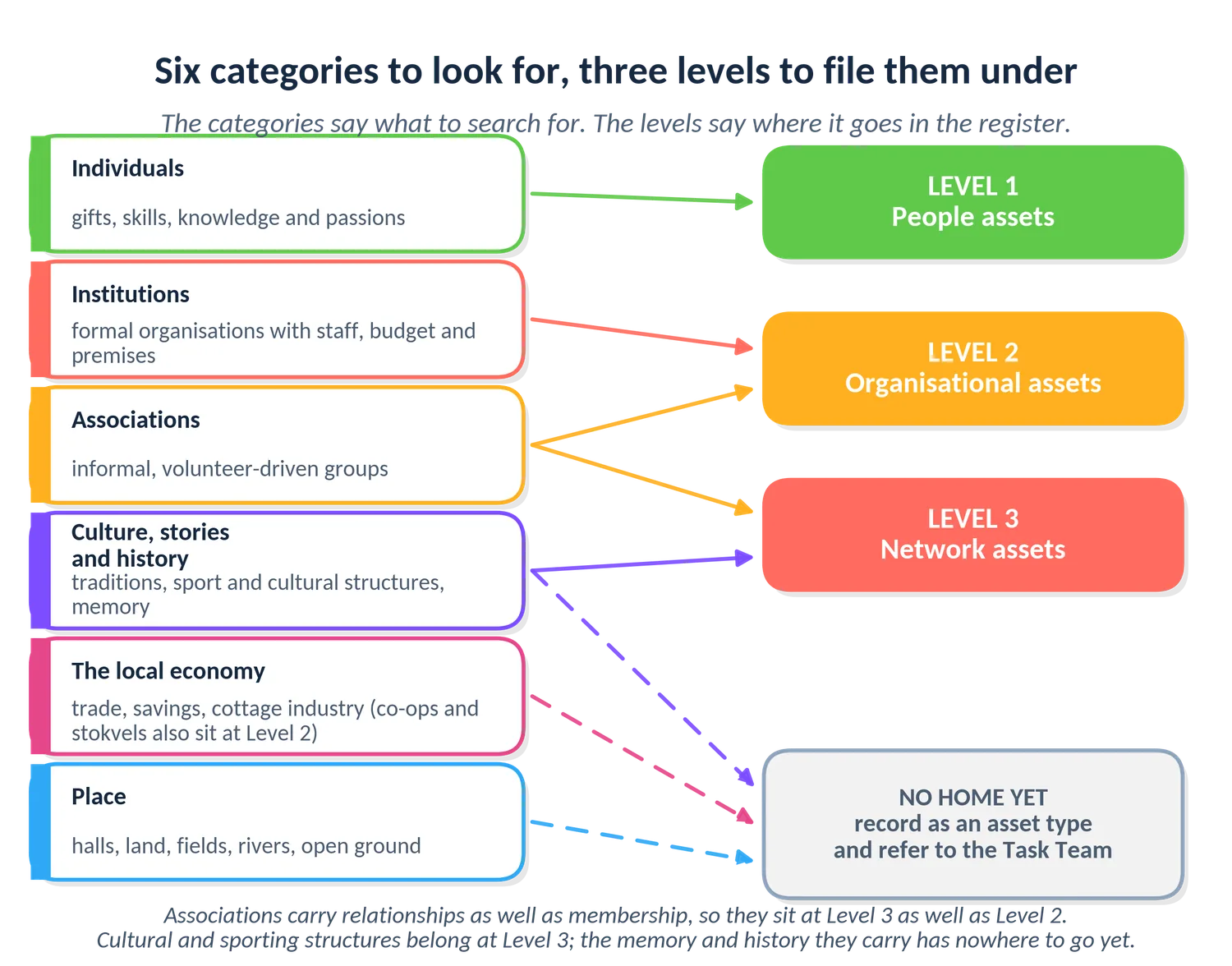
An association runs on the willingness of its members and can act tomorrow; an institution runs on mandate and budget and usually cannot. A node with many institutions and few associations behaves quite differently from one with the reverse, and the register should be able to tell you which you are standing in.
6 · Ways in: stories, timelines and maps
Asset mapping is the method this province has invested in. It is not the only door into a community's strengths, and it is not the easiest door for everyone to walk through. Three things are worth holding in mind: a map is a bird's-eye view, and reading one is a learned skill; people own their stories, and may not feel the same way about a map that arrives with officials and leaves with them; and a map is one moment, while stories unfold. Offer all three, and match the method to the group in front of you.
Storytelling: the view from the inside
Storytelling gives people the chance to explain what life is like from the inside — the emic perspective, the account given from within a community rather than from outside it. It is also the practical route to the sixth category of asset: culture, memory and the shared account of what a place has come through, which cannot be collected on a form.
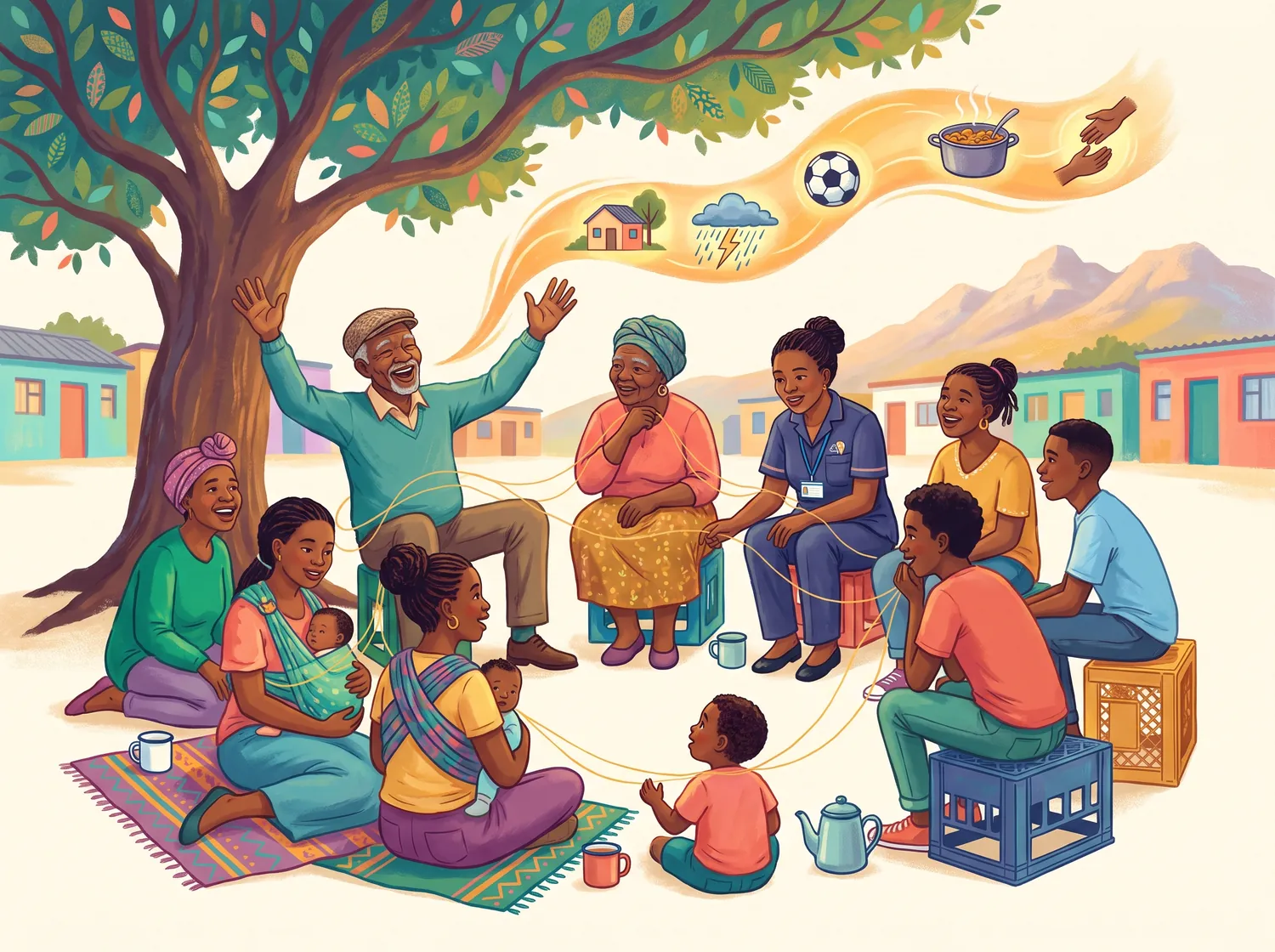
Running a story circle. Invite, do not summon — ask through people the community already trusts. Sit in a circle and say why you are there; agree consent before the first story, not after it. Open with a question people can answer: "Tell us about a time this community got through something hard. What happened, and who helped?" Listen without steering; do not convert the story into a problem list. Follow the helpers: when a story ends, ask who helped, what they did, what they had, and who else does that. Record lightly, with permission. Give it back: read the notes aloud and ask whether they got it right.
A story about a collection taken up for a family after a shack fire yields: at Level 1, the woman who organised it and the driver who gave transport free; at Level 2, the taxi association and the church that housed the family; at Level 3, the phone tree that moved the news through the settlement in under an hour. None appear on any service list. Every one belongs in the asset register, with consent recorded.
The community timeline: memory laid out in a line
A timeline is the simplest possible tool and one of the most powerful. Draw a line, put the earliest memory in the room at one end and today at the other, and let people fill it. It works where a map does not, because it asks for something everyone in the room already has.
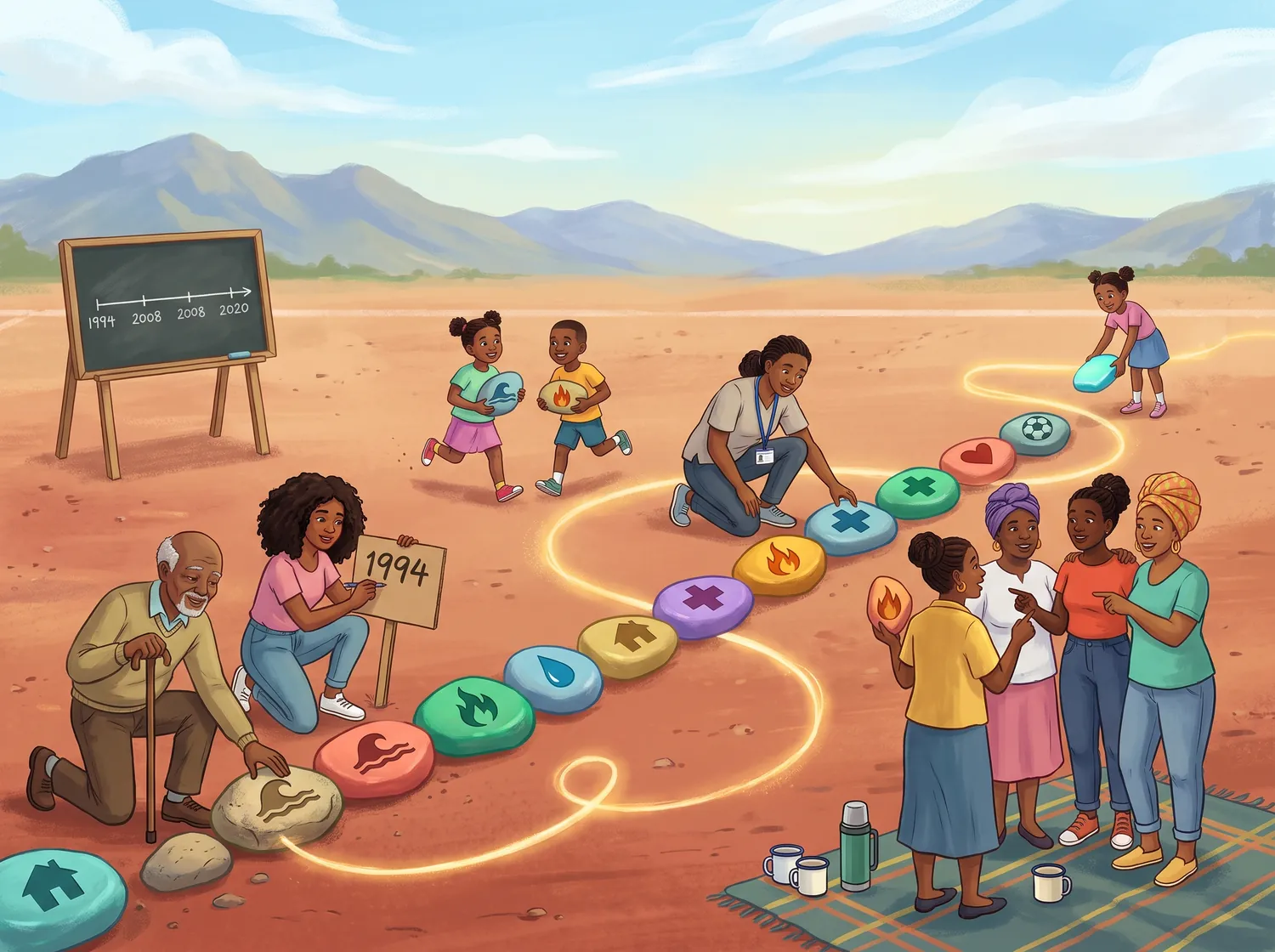
Running a community timeline. Make the line — a blackboard, a roll of paper, a rope on the grass, a line of stones. Start with the oldest memory in the room. Mark the events the community chooses: arrivals and removals, a school built, a factory closed, a flood, a drought, an epidemic. For each event, ask what people did — this is the asset harvest. Finish with what next: leave the last stretch empty and ask what this community intends to do. A timeline that ends at today reads as history; one that runs past today reads as a plan.
Sequence, cause and recovery. A map shows that a settlement sits on a flood plain. A timeline shows that it has flooded three times in twenty years, that the church hall took people in on each occasion, that the second recovery was faster than the first because a phone tree had been built in between, and that the people who ran it are still there. That is a resilience asset, and no map records it.
Choosing and combining the three
| Method | What it is best at | What it needs, and where it falls short |
|---|---|---|
| Story circle | Trust, meaning and the insider view; surfacing people and network assets that no form captures | Needs a listener who will not steer, consent up front, and a plan to give stories back; it will not tell you where things are, or how many |
| Community timeline | History, sequence, change over time, and resilience already proven; honouring elders | Needs someone who can hold a group's memory without directing it; produces order and meaning, not coverage |
| Participatory asset map | A shared picture of place: coordination, coverage, equity analysis and hand-over | Needs map literacy or a facilitator who can build it; a snapshot unless narrated, given back and refreshed |
| GIS layers (Enterprise) | Scale, currency and work across departments and partners | Needs data custodianship and consent discipline; it sees addresses, not relationships or trust |
In practice the three sequence well. Stories open, a timeline deepens, a map organises. Run in that order, the mapping workshop is easier, because by the time the map comes out, the group has already told you most of what belongs on it.
Holding stories with care
A story is given, not collected. Consent first, and specific: consent to tell a story in a circle is not consent to publish it, quote it, or attach a name to it. The story stays the teller's, and may be withdrawn later. Names, contact details and anything about health fall under POPIA. Expect difficult material and prepare for it, with trauma-informed practice that cares for the listener as well as the speaker. Return what you take.
7 · How to do asset mapping, step by step
A practical sequence a PHC team can run over six to ten weeks alongside normal work.
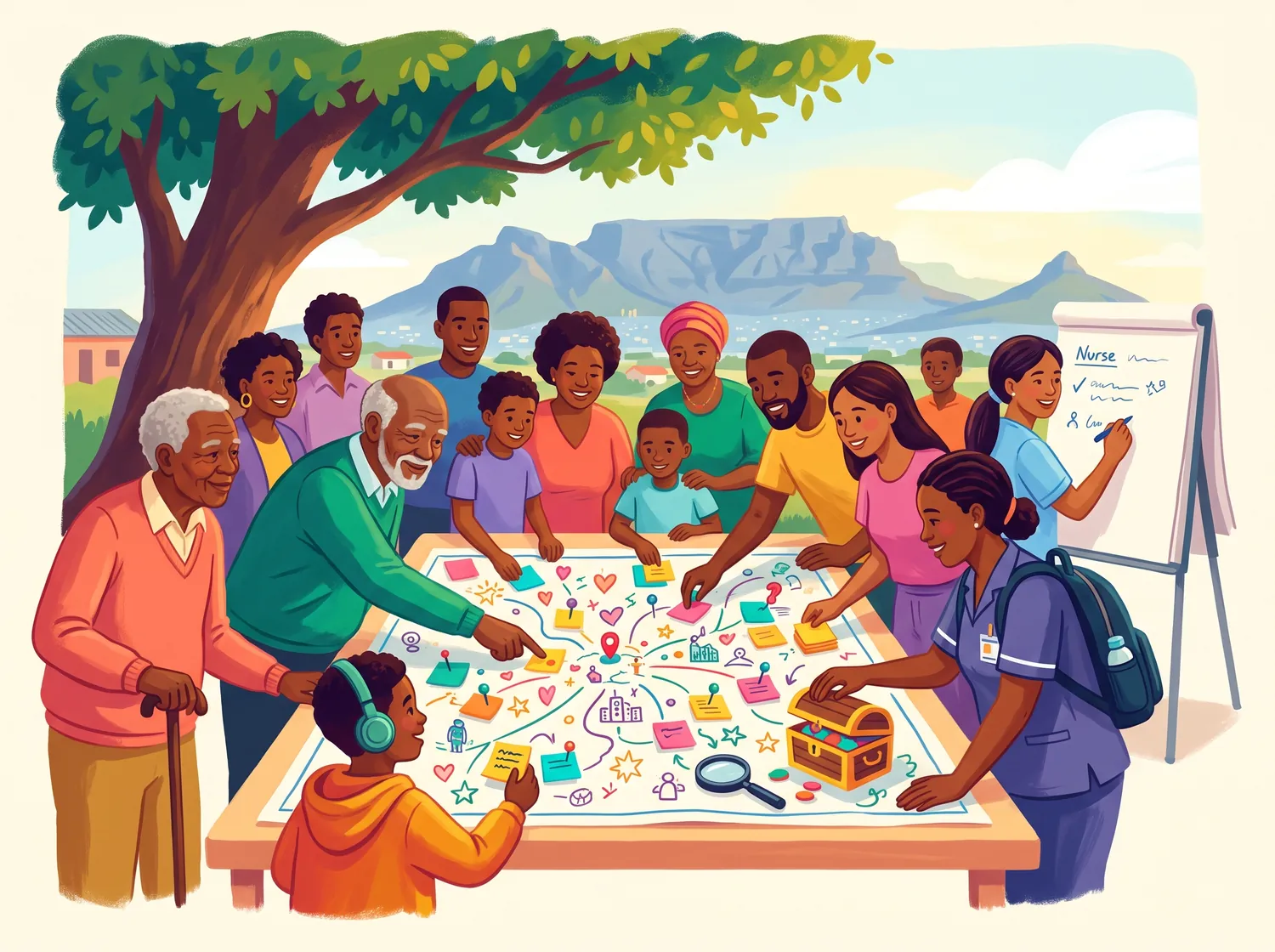
- Step 1 · Define the community and assemble the co-mapping team. Confirm node boundaries with your sub-district. Recruit co-mappers, not respondents: CHWs, forum members, ward committee representatives, well-connected residents. The people who will validate and use the map should help make it.
- Step 2 · Harvest what is already known. Before anyone walks a street, collect facility and NPO service lists, the departmental GIS layers, the community profile, and previous stakeholder mapping. Expect this to be strong on Level 2 and nearly silent on Levels 1 and 3.
- Step 3 · Go and discover (the treasure hunt). Mix methods: community walks; capacity inventories; story circles and timelines; participatory mapping workshops; economic "leaky bucket" mapping. Work through the six categories rather than your own memory, and each cycle add at least one asset category never recorded before.
- Step 4 · Record with volumes, not just names. Capture each asset with its volumetric indicators (reach per month, frequency, geography, capacity for expansion) and an equity note (whom it serves, whom it misses). For people assets, record consent explicitly. Record the category as well as the level.
- Step 5 · Validate and give the map back. Return the draft to the community that made it, correct it together, celebrate it, and leave copies behind. Then update the register on a set rhythm (quarterly works well). Design for ownership from the first meeting: agree who the map belongs to, where the copy will live, and who may update it.
8 · Putting assets on the map: GIS and the ESRI Enterprise platform
Geographic information systems let a practice see its denominator population, its services and its community resources in one view. The Western Cape Government holds an Enterprise ESRI subscription: departments publish and maintain their own layer services — Health maintains facilities and outreach teams, Education maintains schools, Social Development its service points. Nobody has to build a central register of everything; the portal assembles the layers, and each stays current because its own custodian keeps it so.
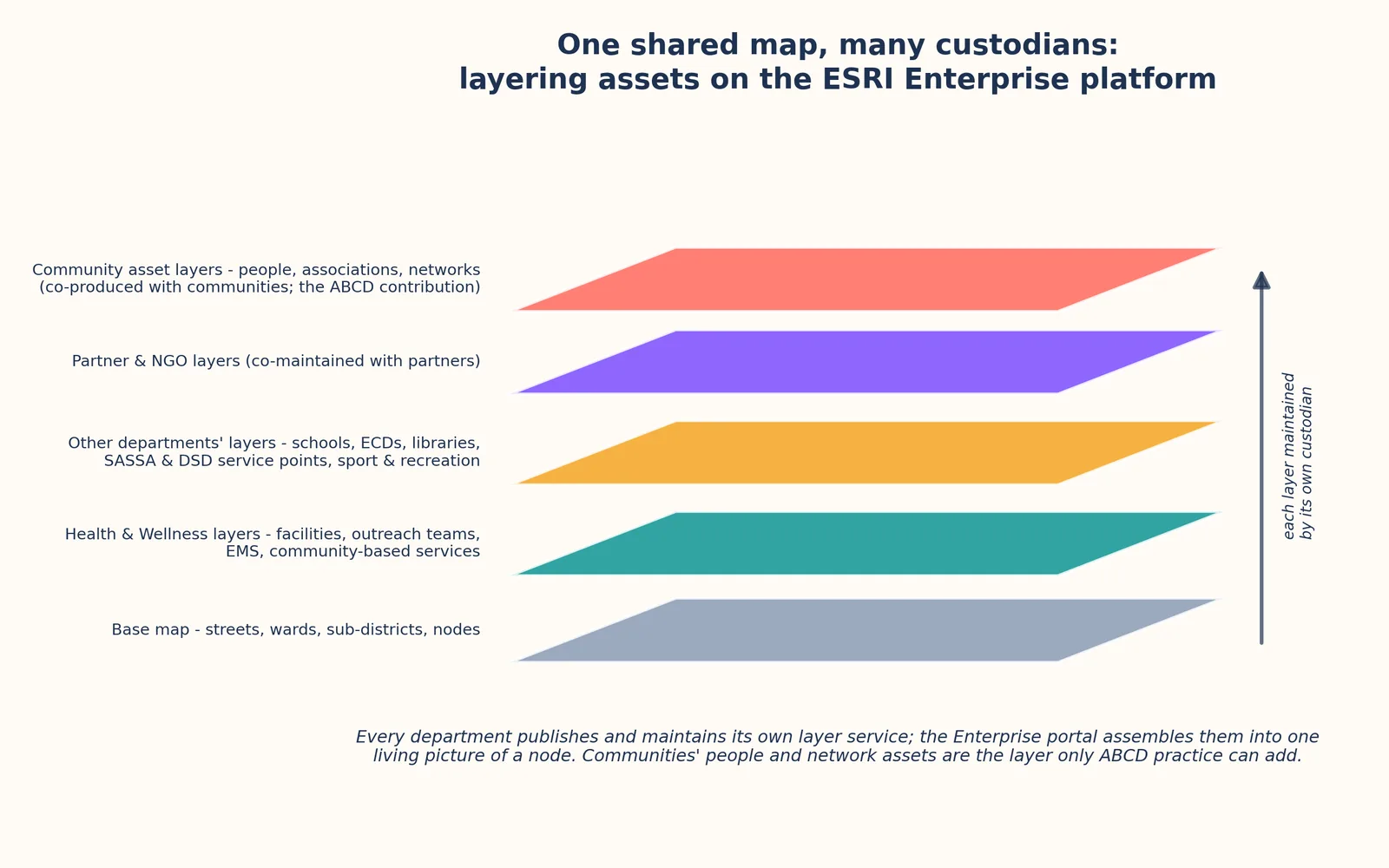
Two practice points follow. First, start by consuming, not creating: load the existing departmental layers for your node and see what the picture already shows. Second, know what the platform cannot see. Institutional layers capture Level 2 assets with an address. They do not capture the retired nurse three streets from the clinic, the WhatsApp group that reaches four hundred households, or the trust between a pastor and the families in an informal settlement. Those Level 1 and Level 3 layers are co-produced with communities.
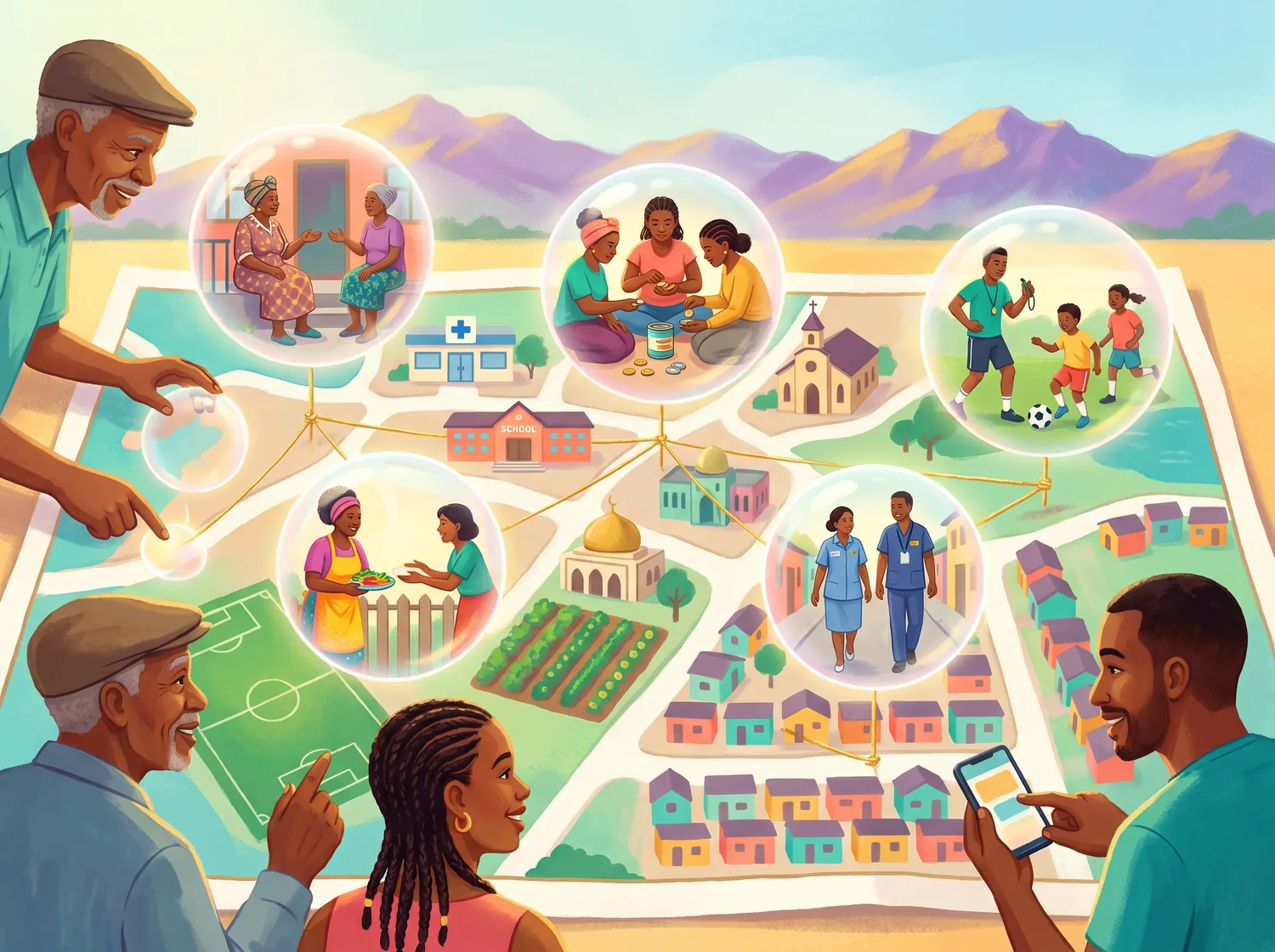
Not every asset should become a point on a public map. People assets require consent and POPIA-compliant handling; some network assets (for example, a support group for gender-based violence survivors) may be endangered by visibility. Map what helps, protect what needs protecting, and record sensitive assets with restricted access rather than on the shared map.
One rule governs all of this: the community holds the master record of what it knows about itself. What sits on the provincial platform is a copy, shared by agreement, for a purpose the community understands, and removable at its request.
9 · After the map: mobilising assets
Here is the uncomfortable truth this guide exists to address: most asset maps are never used. A map that is filed away is a needs assessment in disguise. Working approaches do not do cartography; they raise awareness of the assets available, connect those assets to one another, and enable them to thrive. Mapping is a means. Mobilisation is the point.
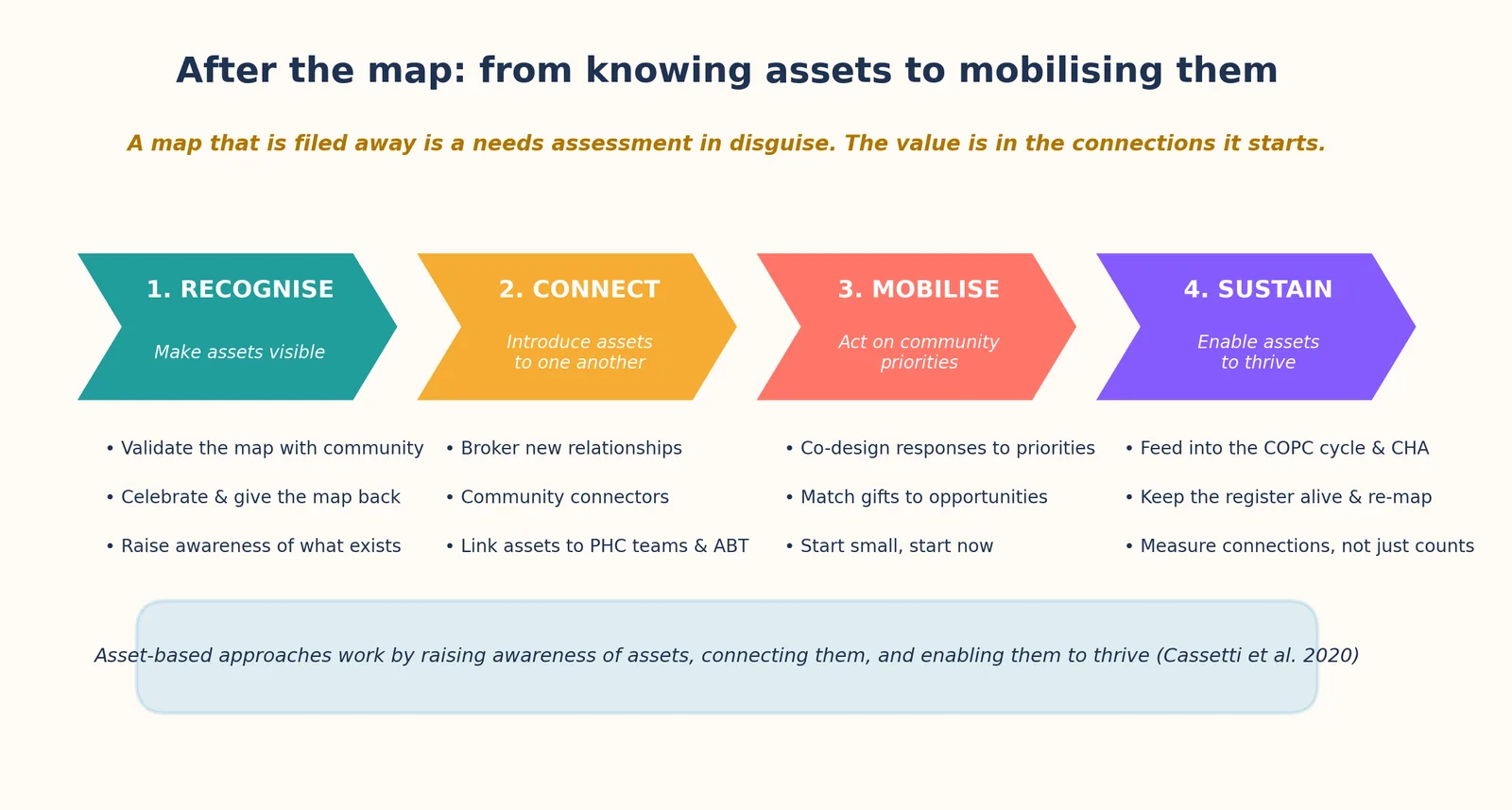
- Recognise: make assets visible. Publicise the validated map. Present it at forums, put it on the clinic wall, give it back to every group that contributed. Communities that see their strengths reflected describe themselves differently, which is where the change process begins.
- Connect: introduce assets to one another. Work through the connectors your mapping identified. Broker specific introductions: the church hall with unused weekday space meets the exercise group with no venue; the retired teacher meets the after-school programme. Every connection is logged, because the connection, not the referral, is the unit of progress.
- Mobilise: act on community priorities through the COPC cycle. Bring the asset map and the community diagnosis to the same prioritisation table, with the community and the ABT in the room. For each priority, ask not only what service must respond but which combination of assets and services will respond. Start small and start now; early wins recruit the next round of assets.
- Sustain: enable assets to thrive. Feed the register into the community health assessment and keep it alive; re-map on a rhythm; support the assets doing the work with small grants, venues, training and recognition. Measure honestly: count connections made, assets active, and community-led actions, not only clinical indicators.
10 · What the evidence says, honestly
COPC itself has reasonable evidence of effectiveness in defined populations, and the Western Cape's own pilot learning sites have shown encouraging service-level signals. The evidence for ABCD's contribution is more modest and should be described as such. A South African comparative study of twenty-four community projects found ABCD-sensitised projects associated with stronger community leadership, participation and organisational change than needs-based equivalents, and case studies from Ethiopia and elsewhere document strong internal cohesion and citizen-led development. But the realist synthesis found no direct evidence yet that ABCD improves clinical health outcomes, and most evaluation comes from high-income settings. The absence of evidence is not evidence of absence; it is a reason to evaluate our own implementation properly rather than to assume, and a reason to keep asset work coupled to COPC's evaluation step.
The same honesty is owed to the methods added in this edition. Narrative methods have a solid record as engagement and health-promotion tools, while their effects at community and societal level are much less well evidenced. Oral history and timeline work is documented as a participatory research method with real influence on how services are designed, rather than as a proven intervention on clinical outcomes. Stories and timelines are included here on the same terms as asset mapping: methods with good reason behind them, to be implemented and evaluated properly rather than assumed to work.
11 · Pitfalls, and how to avoid them
| Pitfall | What it looks like | The remedy |
|---|---|---|
| Mapping as the end | A beautiful register, updated once, used never | Plan mobilisation before you map; put "first connection made" on the project plan, not just "map complete" |
| Extractive mapping | Data flows out of the community; nothing returns | Validate publicly, give the map back, log what the community gained at each step |
| Deficit drift | The "asset" conversation quietly becomes a gap-and-problem list | Open every session with what is working; record strengths before shortfalls |
| Dots without relationships | GIS layers full of points, Level 3 empty | Deliberately map networks: who refers, who trusts, who communicates |
| Overburdening volunteers | The same three community members carry every initiative | Track volunteer load in the register; spread asks; resource what you rely on |
| Substituting for the state | Asset language used to justify service withdrawal | Hold the both/and position: mobilise strengths and advocate for resources |
| Stale registers | The map reflects the community of two years ago | Quarterly refresh rhythm; expanding-discovery rule each cycle |
| One method for every group | A mapping workshop run with people who do not read maps, and the silence read as apathy | Match the method to the group: open with a story circle or timeline, bring the map out later |
| Roll-out thinking | The work set up as a provincial programme with sites, targets and coverage reports | Equip whoever is already convening locally; there is no coverage target |
| Raising expectations | A government meeting implies money and services never budgeted | State at the first meeting what will and will not follow; promise nothing unfunded |
| The centre holding the record | The register lives in a provincial system, ages there, and the community cannot correct it | The community holds the master; the department holds a copy, removable on request |
12 · Quick-start checklist
A one-page sequence for a PHC team starting this quarter:
- Confirm your node boundaries and population with the sub-district.
- Recruit a co-mapping team: CHWs, forum members, ward committee, connected residents.
- Load the existing ESRI departmental layers; harvest existing lists and profiles.
- Run discovery: community walks, capacity inventories, appreciative conversations, a participatory mapping workshop.
- Record every asset at the right level with volumetric and equity notes; obtain consent for people assets.
- Add at least one asset category never recorded before in your node.
- Validate the map with the community and give it back publicly.
- Broker the first three connections between assets within a month of validation.
- Bring the asset map to the next COPC prioritisation with the Area Based Team.
- Set the quarterly refresh; track connections made; report volumetrics to the sub-district.
- Where the group is new to this work, open with a story circle or a timeline before the map.
- Agree consent, ownership and what happens to the material before the first story is told.
- Establish who already convenes here, and whether this is their process or yours.
- Say at the first meeting what will and will not follow; promise nothing that is not funded.
Define your community, find its gifts at three levels, put them on the shared map, give the map back, connect the gifts to each other and to your COPC priorities, and keep the register alive.
13 · Glossary
| Term | Meaning |
|---|---|
| ABCD | Asset-Based Community Development: a strengths-oriented approach that begins by identifying and mobilising the capacities of individuals, associations and institutions |
| ABT | Area Based Team: the multi-sectoral team responsible for community-level action in a defined geographic area |
| Asset register | The living record of a node's people, organisational and network assets, with volumetric and equity indicators |
| Association | An informal, volunteer-driven group formed around a shared interest, which runs on relationships rather than mandate and can usually act quickly |
| Capacity inventory | A structured conversation recording an individual's skills, experience and willingness to contribute |
| CHW | Community health worker |
| Community resilience | A community's capacity to absorb a shock and recover, depending on relationships, information and local organisation as much as on services |
| Community timeline | A participatory method laying out a community's history along a line, from the earliest memory in the room to what it intends to do next |
| Connector | A person whose relationships span otherwise unconnected groups, and who can broker introductions between assets |
| COPC | Community-Oriented Primary Care: continuous, cyclical primary care for a defined community based on assessed needs, integrating primary care with public health |
| Emic perspective | The account of a situation given from inside a community, in its own terms |
| Institution | A formal organisation with staff, budget and premises, whose usable assets are often its space, equipment and expertise rather than its programme |
| Node | The demarcated geographic community a COPC team serves |
| POPIA | The Protection of Personal Information Act, governing how personal information may be collected, stored and used |
| Salutogenesis | The study of the origins of health: what keeps people well, rather than what makes them sick |
| Stokvel | A community-based savings and mutual-support group |
| Volumetric measurement | Characterising each asset by scale and reach (people served, frequency, coverage, capacity), not just existence |
Acknowledgements
This guide incorporates and builds on the ABCD Task Team's Asset Mapping Framework, which established the three-level structure, the guiding principles and the volumetric approach. Thanks to the ABCD Task Team for assembling the literature corpus, and to the COPC pilot site teams whose learning informs the provincial position. This edition was strengthened by a detailed review from Prof Steve Reid, whose case for storytelling and the community timeline as ways into asset-based practice is carried in Section 6. It was compiled with the assistance of Anthropic's Claude Fable 5, working from the framework, literature corpus and provincial policy documents.
Queries: the ABCD Task Team, Western Cape Department of Health and Wellness — Robin Dyers, Naseef Abdullah, Riyaadh Dawood, Mitzi Franken, Ruwayda Hull, Nicolette van der Walt and Hellen Motloung.
References
- Abdullah, N. 2026. Asset Mapping Framework for Community-Oriented Primary Care in the Western Cape.
- Abramson, J.H. 1988. Community-oriented primary care: Strategy, approaches, and practice: A review. Public Health Reviews, 16(1-2): 35–98.
- Aldrich, D.P. & Meyer, M.A. 2015. Social capital and community resilience. American Behavioral Scientist, 59(2): 254–269.
- Antonovsky, A. 1996. The salutogenic model as a theory to guide health promotion. Health Promotion International, 11(1): 11–18.
- Bam, N., Marcus, T., Hugo, J. & Kinkel, H.-F. 2013. Conceptualizing community oriented primary care (COPC): The Tshwane, South Africa, health post model. African Journal of Primary Health Care & Family Medicine, 5(1): a423.
- Bazemore, A., Phillips, R.L. & Miyoshi, T. 2010. Harnessing Geographic Information Systems (GIS) to enable community-oriented primary care. J Am Board Fam Med, 23(1): 22–31.
- Blickem, C. et al. 2018. What is asset-based community development and how might it improve the health of people with long-term conditions? A realist synthesis. SAGE Open, 8(3).
- Calabria, V. & Bailey, D. 2023. Participatory action research and oral history as natural allies in mental health research. Qualitative Research, 23(3): 668–685.
- Cassetti, V., Powell, K., Barnes, A. & Sanders, T. 2020. A systematic scoping review of asset-based approaches to promote health in communities: Development of a framework. Global Health Promotion, 27(3): 15–23.
- Field, S. 2007. Oral history methodology.
- Foot, J. & Hopkins, T. 2010. A Glass Half-Full: How an Asset Approach Can Improve Community Health and Well-being.
- Friedli, L. 2013. 'What we've tried, hasn't worked': The politics of assets based public health. Critical Public Health, 23(2): 131–145.
- Gavagan, T. 2008. A systematic review of COPC: evidence for effectiveness. J Health Care Poor Underserved, 19(3): 963–980.
- Geiger, H.J. 2002. Community-oriented primary care: a path to community development. Am J Public Health, 92(11): 1713–1716.
- Glasgow Centre for Population Health. 2011. Asset Based Approaches for Health Improvement: Redressing the Balance (Concepts Series 9).
- Glasgow Centre for Population Health. 2012. Putting Asset Based Approaches into Practice (Concepts Series 10).
- Gofin, J. & Gofin, R. 2005. Community-oriented primary care and primary health care. Am J Public Health, 95(5): 757.
- Gubrium, A. 2009. Digital storytelling: An emergent method for health promotion research and practice. Health Promotion Practice, 10(2): 186–191.
- Gubrium, A.C., Hill, A.L. & Flicker, S. 2014. A situated practice of ethics for participatory visual and digital methods in public health research and practice. Am J Public Health, 104(9): 1606–1614.
- Hove, J. et al. 2022. Lessons from community participation in primary health care and water resource governance in South Africa: A narrative review. Glob Health Action, 15(1): 2004730.
- Kark, S.L., Kark, E. & Abramson, J.H. 1993. Commentary: in search of innovative approaches to international health. Am J Public Health, 83(11): 1533–1536.
- Kleinman, A. & Benson, P. 2006. Anthropology in the clinic: The problem of cultural competency and how to fix it. PLoS Med, 3(10): e294.
- Kretzmann, J.P. & McKnight, J. 1993. Building Communities from the Inside Out: A Path Toward Finding and Mobilizing a Community's Assets. Evanston, Ill.: ABCD Institute, Northwestern University.
- Kretzmann, J.P., McKnight, J.L. & Sheehan, G. 1997. A Guide to Capacity Inventories: Mobilizing the Community Skills of Local Residents.
- Lightfoot, E., McCleary, J.S. & Lum, T. 2014. Asset mapping as a research tool for community-based participatory research in social work. Social Work Research, 38(1): 59–64.
- Lohr, A.M. et al. 2022. The use of digital stories as a health promotion intervention: A scoping review. BMC Public Health, 22(1): 1180.
- Longlett, S.K., Kruse, J.E. & Wesley, R.M. 2001. Community-oriented primary care: historical perspective. J Am Board Fam Pract, 14(1): 54–63.
- Lung-Amam, W.S. & Dawkins, C.J. 2020. The power of participatory story mapping: Advancing equitable development in disadvantaged neighbourhoods. Community Development Journal, 55(3): 473–495.
- Macleod, M.A. & Emejulu, A. 2014. Neoliberalism with a community face? A critical analysis of asset-based community development in Scotland. Journal of Community Practice, 22(4): 430–450.
- Marcus, T.S. 2015. A Practical Guide to Doing Community Oriented Primary Care.
- Mash, R., Goliath, C., Mahomed, H., Reid, S., Hellenberg, D. & Perez, G. 2020. A framework for implementation of community-orientated primary care in the Metro Health Services, Cape Town, South Africa. African Journal of Primary Health Care & Family Medicine, 12(1): a2632.
- Mash, R., Ray, S., Essuman, A. & Burgueño, E. 2019. Community-orientated primary care: A scoping review of different models, and their effectiveness and feasibility in sub-Saharan Africa. BMJ Global Health, 4(Suppl 8): e001489.
- Mathie, A. & Cunningham, G. 2003. From clients to citizens: Asset-based community development as a strategy for community-driven development. Development in Practice, 13(5): 474–486.
- McKnight, J. 1995. The Careless Society: Community and Its Counterfeits.
- McKnight, J.L. & Russell, C. 2018. The four essential elements of an asset-based community development process.
- Mengesha, S.K., Meshelemiah, J.C.A. & Chuffa, K.A. 2015. Asset-based community development practice in Awramba, Northwest Ethiopia. Community Development, 46(2): 164–179.
- Morgan, A. & Ziglio, E. 2007. Revitalising the evidence base for public health: An assets model. Promotion & Education, 14(2 Suppl): 17–22.
- Mullan, F. & Epstein, L. 2002. Community-oriented primary care: New relevance in a changing world. Am J Public Health, 92(11): 1748–1755.
- Nel, H. 2018. Community leadership: A comparison between asset-based community-led development (ABCD) and the traditional needs-based approach. Development Southern Africa, 35(6): 839–851.
- Norris, F.H. et al. 2008. Community resilience as a metaphor, theory, set of capacities, and strategy for disaster readiness. Am J Community Psychol, 41(1-2): 127–150.
- Osei-Tutu, A.a.Z. 2023. Developing African oral traditional storytelling as a framework for studying with African peoples. Qualitative Research, 23(6): 1497–1514.
- Susser, M. 1999. Pioneering community-oriented primary care. Bull World Health Organ, 77(5): 436–438.
- Tollman, S.M. 1994. The Pholela Health Centre: The origins of community-oriented primary health care (COPC). South African Medical Journal, 84(10): 653–658.
- Van Ryneveld, M., Whyle, E. & Brady, L. 2022. What is COVID-19 teaching us about community health systems? A reflection from a rapid community-led mutual aid response in Cape Town, South Africa. Int J Health Policy Manag, 11(1): 5–8.
- Walsh, H.L. 2025. Caring by communities in times of crisis: A rationale for a trauma-informed oral history methodology. Community Development, 57(2): 202–216.
- Ward, B. & Lewis, J. 2002. Plugging the Leaks: Making the Most of Every Pound That Enters Your Local Economy.
- Western Cape Department of Health and Wellness. 2024. Metro Health Services COPC Implementation Toolkit. Cape Town.
- Western Cape Government Health. 2023. Position statement on community-oriented primary care (COPC) towards universal health coverage (UHC). Cape Town.
- Wilkinson, A., Parker, M., Martineau, F. & Leach, M. 2017. Engaging 'communities': Anthropological insights from the West African Ebola epidemic. Philosophical Transactions of the Royal Society B, 372(1721): 20160305.