Foundations & evidence · A research review
Where this comes from, and what the evidence shows.
Asset-Based Community Development, its relationship with Community-Oriented Primary Care, its practical methods, documented applications in low- and middle-income countries, the main critiques, and an honest account of what the evidence does and does not yet support.
In-text referencing follows the Harvard convention; a full reference list appears at the end. Prepared July 2026.
Executive summary
Asset-Based Community Development (ABCD) is a strengths-oriented approach to community change that begins by identifying and mobilising the capacities of individuals, associations, and institutions rather than cataloguing a community's deficits and needs (Kretzmann and McKnight, 1993). Over three decades it has moved from its origins in North American neighbourhood organising into international development practice and, more recently, into public health and primary care. This review examines three matters of interest to service reform: how ABCD relates to and complements Community-Oriented Primary Care (COPC); the practical methods of ABCD, namely asset mapping, mobilisation, and usage; and documented applications in low- and middle-income countries (LMICs), with attention to what the evidence does and does not support. It closes with the main critiques, which caution that an asset lens can be turned toward depoliticising structural inequality, and with the observation that rigorous health-outcome evidence from LMIC settings remains thin.
1 · Foundations and principles of ABCD
Origins
ABCD was articulated by John Kretzmann and John McKnight of Northwestern University, whose 1993 book Building Communities from the Inside Out drew on fieldwork in more than 300 low-income neighbourhoods across roughly twenty United States cities (Kretzmann and McKnight, 1993). The approach was a deliberate response to what McKnight (1995) called the "careless society", in which strong professionalised service systems can weaken communities by recasting citizens as clients and consumers of services. Against this, ABCD proposes that sustainable community change is led from the "inside out", building first on internal capacities before drawing in external resources.
Core principles
Four commitments distinguish ABCD from conventional needs-based practice. The approach is asset-based rather than deficit-based, beginning with a community's gifts and capacities rather than its problems; it is internally focused, prioritising the agency of residents and local associations; it is relationship-driven, treating the connection of people to one another as the engine of change; and it is citizen-led, positioning residents as producers of their own development rather than recipients of services (Kretzmann and McKnight, 1993; Mathie and Cunningham, 2003). This is often summarised through the metaphor of the community as a "glass half-full" rather than half-empty (Foot and Hopkins, 2010). The emphasis on voluntary associations and civic networks draws on the social-capital tradition, in which associational life generates the trust and reciprocity that underpin collective action (Putnam, 2000).
Categories of assets
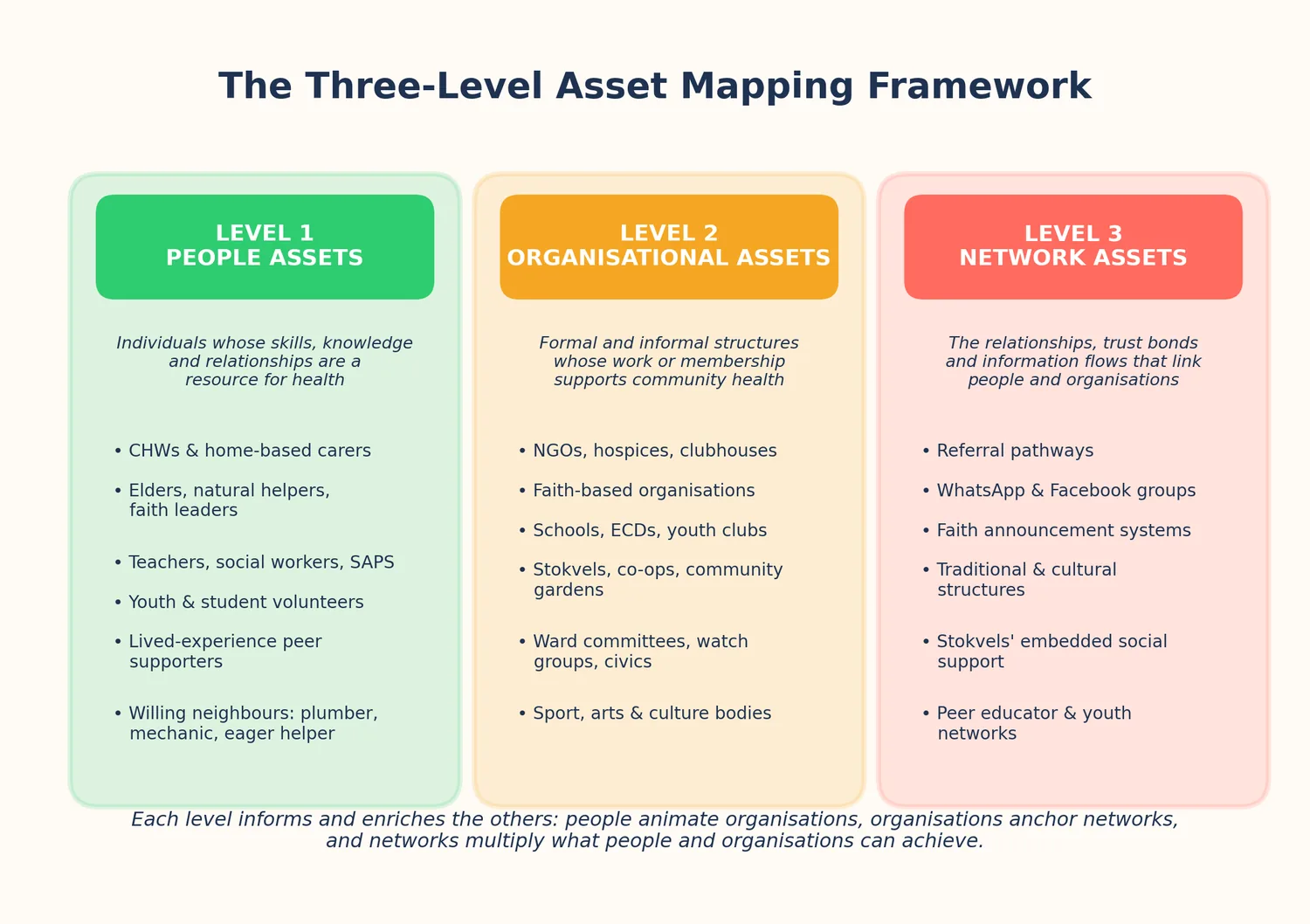
ABCD organises a community's resources into a set of asset categories that structure the mapping exercise. Kretzmann and McKnight (1993) located assets that lie "inside the neighbourhood and under neighbourhood control": the gifts, skills, and capacities of individuals; the power of local voluntary associations; the resources of local institutions such as schools, clinics, and libraries; physical and place-based assets such as land and buildings; and the local economy of exchange. Later ABCD literature commonly renders this as a six-fold typology by adding cultural assets and community stories, though this tidy list is a synthesis of the tradition rather than a verbatim formulation in the 1993 text (McKnight and Kretzmann, 1996).
2 · ABCD and Community-Oriented Primary Care
What COPC is
Community-Oriented Primary Care has a longer lineage than ABCD and, notably for a South African readership, a shared point of origin. The model was pioneered in the 1940s by Sidney and Emily Kark at the Pholela Health Centre in rural Natal, where curative care was integrated with community health work for a defined population (Tollman, 1994). Contemporaries regarded the Karks' innovations as foundational to global public health, with Susser (1993) describing them as assembling the girders on which the later Alma-Ata Declaration would rest. COPC is best understood as a continuous, cyclical practice. Abramson (1988) set out its core sequence of community diagnosis, prioritisation, intervention, and evaluation, and Mullan and Epstein (2002) offered the widely used definition of COPC as a continuous process by which primary health care is provided to a defined community on the basis of its assessed health needs, through the planned integration of primary care practice and public health. A systematic review has found evidence that the model can improve health outcomes in defined populations (Gavagan, 2008).
Points of convergence
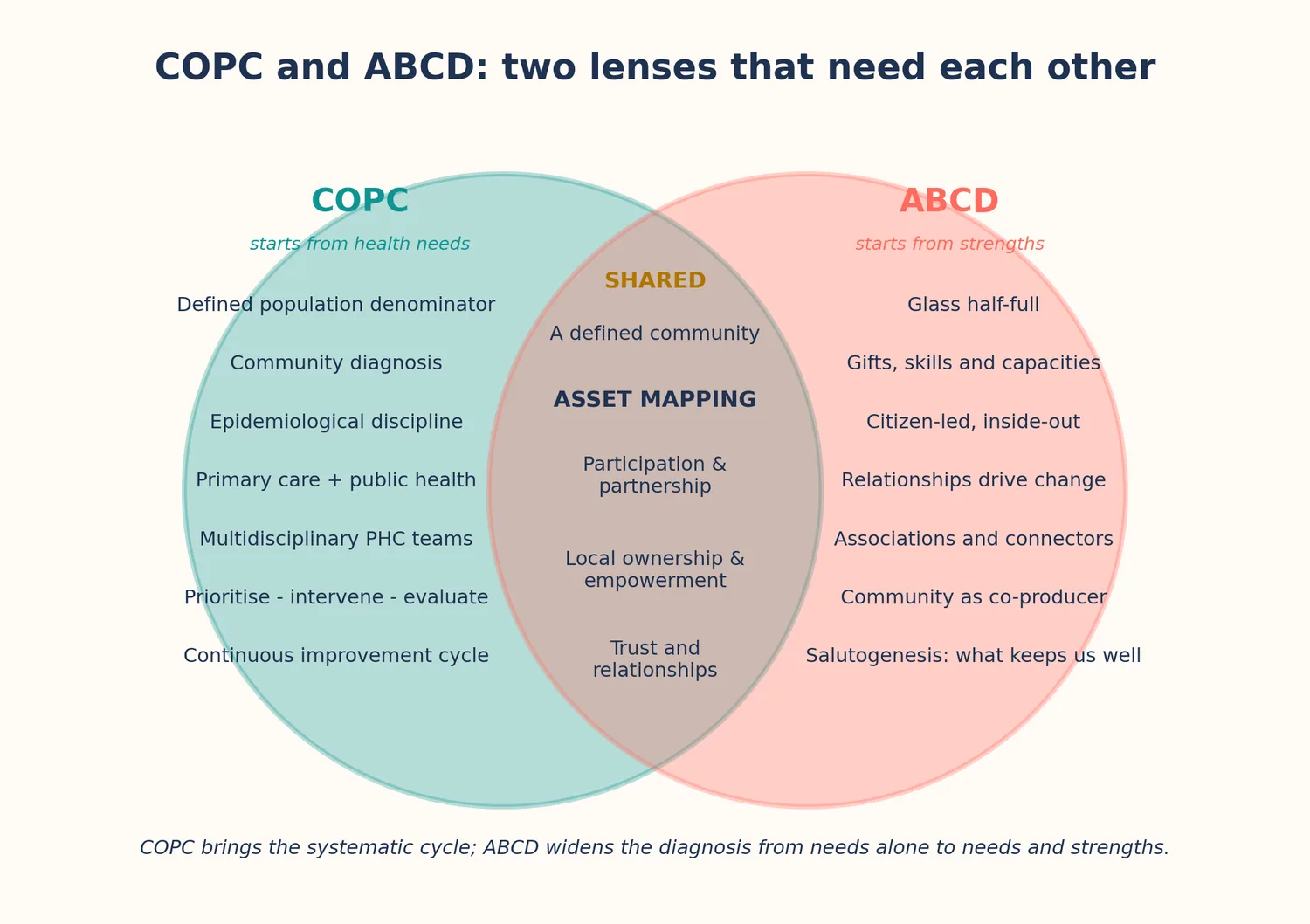
ABCD and COPC share three defining features that make them natural partners. Both work with a defined community or population rather than an undifferentiated public; both treat community participation as constitutive of good practice rather than an optional extra; and both aim at empowerment and local ownership. COPC contributes a systematic epidemiological cycle and the integration of clinical care with population health, while ABCD contributes a strengths orientation and a mapping methodology (Mathie and Cunningham, 2003; Mullan and Epstein, 2002). Asset mapping can be folded directly into community health assessment so that partnerships between health systems and communities are built on local strengths rather than deficits alone (Harrison et al., 2019).
Explicit integration in South Africa
The clearest published fusion of the two approaches has emerged in South Africa's re-engineering of primary health care. The University of Pretoria's Department of Family Medicine developed a COPC model for Tshwane that operationalises the approach through household- and community-focused health-post teams, situating COPC within the national programme of ward-based outreach (Bam et al., 2013; Marcus et al., 2017). The most explicit bridge appears in the Western Cape, where the Metro Health Services framework for implementing COPC is described as being based on asset-based thinking, pairing community health worker-led household assessment through the COPC cycle with community engagement to co-define available health resources and needs (Mash et al., 2020). A scoping review of COPC across sub-Saharan Africa situates community participation and asset-informed approaches within COPC implementation on the continent (Mash et al., 2019).
Tensions between the approaches
The integration is not seamless. COPC's community diagnosis is oriented toward identifying and addressing unmet need and the social determinants of health, whereas ABCD reacts against deficit framing and can, in some formulations, understate material disadvantage. The concern that an asset emphasis may be used to reframe rather than remedy structural inequality (MacLeod and Emejulu, 2014) is a live tension for any programme that grafts ABCD onto a needs-driven public-health cycle. A defensible synthesis treats the two as complementary diagnostics: the asset lens widens the community diagnosis without displacing the epidemiological assessment of need.
3 · Asset mapping, mobilisation, and usage
Asset mapping
Asset mapping is the practical core of ABCD, a strengths-based participatory method that makes a community's resources visible and, where relevant, locates them geographically (Lightfoot, McCleary and Lum, 2014). At the level of the individual, the capacity inventory is a structured survey that records residents' skills, abilities, and experience, organised around the gifts of the head, the hands, and the heart (Kretzmann, McKnight and Sheehan, 1997). At the associational and institutional levels, mapping catalogues the voluntary networks and formal organisations a community can mobilise. Techniques include community walks, resident interviews and surveys, appreciative inquiry that begins from what is working well, storytelling, and participatory geographic information systems (Lightfoot, McCleary and Lum, 2014; Foot and Hopkins, 2010). Economic mapping is served by the "leaky bucket" tool, in which residents trace the inflows and outflows of money in the local economy (Ward and Lewis, 2002; Cunningham, 2008).
Mobilisation
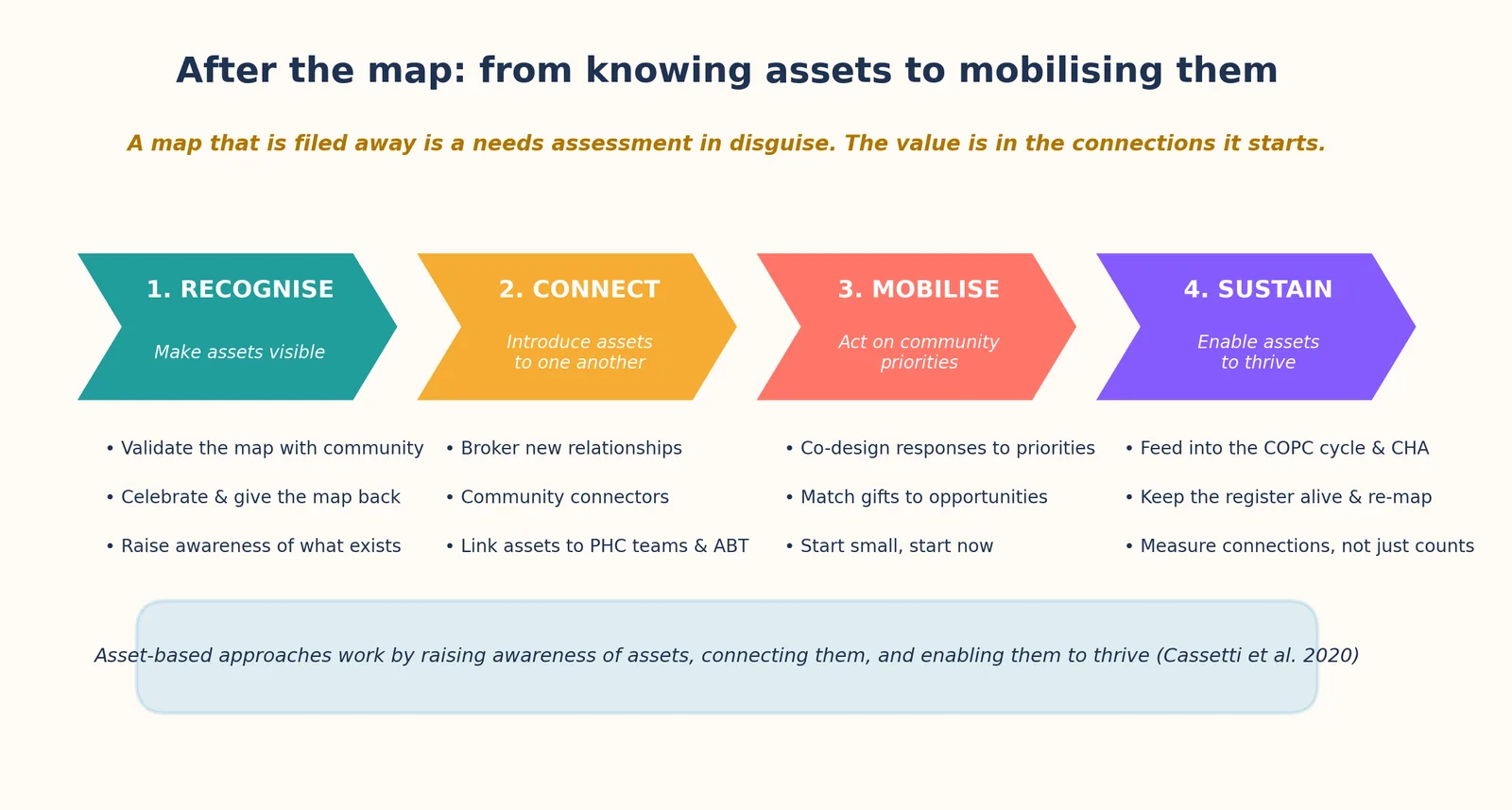
Mapping is a means, not an end. Mobilisation is the work of connecting and activating identified assets so that they act on community-defined goals. A systematic scoping review distilled three recurring characteristics of asset-based approaches: raising awareness of the assets that are available, connecting those assets to one another, and enabling assets to thrive (Cassetti et al., 2020). In practice this depends on community connectors or animators who broker relationships across previously unconnected people and groups, on the deliberate building of social capital, and on citizen-led action (Mathie and Cunningham, 2003).
Usage and the health-promotion strand
Usage refers to putting mobilised assets to work and linking internal community resources to external institutional support in a way that sustains local ownership. The application of asset thinking to health rests on a distinct theoretical lineage. Antonovsky's (1996) salutogenic model reoriented health promotion toward the origins of health and the "sense of coherence" that allows people to draw on resources to stay well. Morgan and Ziglio (2007) built on this to propose an assets model for public health that foregrounds protective and health-promoting factors rather than deficits and risks. These ideas were made accessible through the "glass half-full" report (Foot and Hopkins, 2010) and synthesised by the Glasgow Centre for Population Health (2011), which argues for redressing the balance between deficit and asset thinking rather than abandoning either. A realist synthesis has since clarified the mechanisms by which mobilised assets might improve health (Blickem et al., 2018).
4 · Case studies in low- and middle-income countries
Ethiopia
Ethiopia hosts the most fully documented ABCD programme in the international development literature. Working with the Coady International Institute, Oxfam Canada, and Ethiopian NGOs, practitioners stimulated asset-based, community-driven development across five communities (Cunningham, 2008; Mathie and Cunningham, 2008). A qualitative case study of the Awramba community found that it substantially practised the principles of ABCD, including shared meaning, full participation, and internally focused development supported by strong bonding social capital, though with weaker external linkages (Mengesha, Meshelemiah and Chuffa, 2015). The Awramba finding illustrates a recurring pattern: strong internal cohesion is easier to build than productive links to external institutions.
South Africa
South African research has tended to integrate ABCD with the sustainable-livelihoods framework, which offers a fuller account of material vulnerability (Nel, 2015). In a comparative study of twenty-four community projects, of which fourteen had been sensitised to ABCD and ten had not, Nel (2018) found the ABCD projects associated with stronger community leadership, participation, and organisational change than those following a traditional needs-based approach. Further work has examined the challenges of combining ABCD with sustainable livelihoods in Tshwane (Skhosana, 2025), and a community asset-mapping programme has been designed to drive roots-driven socio-economic change in rural areas (Nicolau and Delport, 2015).
Asia and West Africa
Evidence from Asia is more dispersed. A comparative analysis of cases in India and Bangladesh examined how social capital facilitates mutual support, income generation, and community governance (Bhuiyan, 2011); work in Mindanao, the Philippines, has shown how ABCD can be adapted to diverse cultural and linguistic contexts (Hill et al., 2022). In West Africa, a recent quantitative study assessed the effect of an ABCD approach on rural poverty alleviation in Ghana and tested the moderating role of government policy, extending the evidence base beyond the qualitative case-study tradition (Chen et al., 2024). Cross-regional analysis has argued, through a "diffracted power" lens, that ABCD can reverse internalised powerlessness and strengthen collective action (Mathie, Cameron and Gibson, 2017).
The state of the evidence
First, the strongest health-specific syntheses of ABCD draw on an evidence base that is predominantly from high-income countries; the realist synthesis by Blickem et al. (2018) reviewed twenty-nine papers, found none focused specifically on long-term conditions, and concluded that direct evidence of improved health outcomes was lacking. Second, rigorous ABCD health-outcome evaluations set in LMICs are notably thin, and much of the LMIC literature is qualitative or livelihoods-adjacent rather than health-focused. The absence of such evidence is not evidence of absence, but it marks a clear gap for future research and a reason for caution in claims-making.
5 · Critiques and limitations
ABCD attracts a coherent body of criticism that any service-reform application should confront directly. The most prominent charge is that ABCD can function as "neoliberalism with a community face", a formulation MacLeod and Emejulu (2014) developed from the Scottish experience, in which an asset discourse can legitimise funding cuts by shifting responsibility onto communities. Friedli (2013) argues that asset-based public health can abstract psycho-social factors from material realities and function as an alternative to addressing power and the political production of inequality. A parallel critique in social care warns that asset approaches risk legitimising the retrenchment of state provision and over-burdening individuals and communities (Daly and Westwood, 2018). These critiques are not decisive. Roy (2017) found that practitioners themselves frame asset approaches as ways of mitigating poverty and rebuilding collectivism, ideals that predate neoliberalism. The reasonable position for practice is that an asset orientation should supplement, not supplant, attention to structural determinants and the state's obligations.
6 · Implications for service reform
For a programme integrating ABCD with COPC, three points follow from the literature. The asset lens is best treated as an extension of the community diagnosis rather than a replacement for the assessment of need, preserving COPC's epidemiological discipline while widening its view of community resources (Mash et al., 2020). The methods of mapping, mobilisation, and usage are well developed and can be embedded in ward-based outreach and community health worker practice with modest adaptation (Marcus, 2015; Glasgow Centre for Population Health, 2012). And claims about health outcomes should be made carefully, since the LMIC health-outcome evidence base remains limited and calls for local evaluation rather than assumption (Blickem et al., 2018).
Reference list
- Abramson, J.H. (1988) 'Community-oriented primary care: strategy, approaches, and practice: a review', Public Health Reviews, 16(1-2), pp. 35–98.
- Antonovsky, A. (1996) 'The salutogenic model as a theory to guide health promotion', Health Promotion International, 11(1), pp. 11–18.
- Bam, N., Marcus, T., Hugo, J. and Kinkel, H.-F. (2013) 'Conceptualizing community oriented primary care (COPC): the Tshwane, South Africa, health post model', African Journal of Primary Health Care & Family Medicine, 5(1), a423.
- Bhuiyan, S.H. (2011) 'Social capital and community development: an analysis of two cases from India and Bangladesh', Journal of Asian and African Studies, 46(6), pp. 533–545.
- Blickem, C., Dawson, S., Kirk, S., Vassilev, I., Mathieson, A., Harrison, R., Bower, P. and Lamb, J. (2018) 'What is asset-based community development and how might it improve the health of people with long-term conditions? A realist synthesis', SAGE Open, 8(3).
- Cassetti, V., Powell, K., Barnes, A. and Sanders, T. (2020) 'A systematic scoping review of asset-based approaches to promote health in communities: development of a framework', Global Health Promotion, 27(3), pp. 15–23.
- Chen, H. et al. (2024) 'Assessing the impact of asset-based community development approach on rural poverty alleviation in Ghana: the moderating role of government policies', SAGE Open, 14(1).
- Cunningham, G. (2008) 'Stimulating asset-based and community-driven development: lessons from five communities in Ethiopia', in Mathie, A. and Cunningham, G. (eds) From Clients to Citizens. Rugby: Practical Action Publishing, pp. 261–298.
- Daly, M. and Westwood, S. (2018) 'Asset-based approaches, older people and social care: an analysis and critique', Ageing & Society, 38(6), pp. 1087–1099.
- Eliasov, N. and Peters, B. (2014) Voices in Harmony: Stories of Community-Driven Development in South Africa. Antigonish: Coady International Institute.
- Foot, J. (2012) What Makes Us Healthy? The Asset Approach in Practice. London: Local Government Association.
- Foot, J. and Hopkins, T. (2010) A Glass Half-Full: How an Asset Approach Can Improve Community Health and Well-being. London: Improvement and Development Agency.
- Friedli, L. (2013) '"What we've tried, hasn't worked": the politics of assets based public health', Critical Public Health, 23(2), pp. 131–145.
- Gavagan, T. (2008) 'A systematic review of COPC: evidence for effectiveness', Journal of Health Care for the Poor and Underserved, 19(3), pp. 963–980.
- Glasgow Centre for Population Health (2011) Asset Based Approaches for Health Improvement: Redressing the Balance (Concepts Series 9). Glasgow: GCPH.
- Glasgow Centre for Population Health (2012) Putting Asset Based Approaches into Practice (Concepts Series 10). Glasgow: GCPH.
- Gofin, J. and Gofin, R. (2005) 'Community-oriented primary care and primary health care', American Journal of Public Health, 95(5), p. 757.
- Harrison, R., Blickem, C., Lamb, J., Kirk, S. and Vassilev, I. (2019) 'Asset-based community development: narratives, practice, and conditions of possibility: a qualitative study with community practitioners', SAGE Open, 9(1).
- Hill, A., Mercado, A.B., Fuentes, A.S. and Hill, D. (2022) 'Asset-based community development in diverse cultural contexts: learning from Mindanao, the Philippines', in Languages, Linguistics and Development Practices. Cham: Springer, pp. 59–86.
- Kretzmann, J.P. and McKnight, J.L. (1993) Building Communities from the Inside Out: A Path Toward Finding and Mobilizing a Community's Assets. Chicago: ACTA Publications.
- Kretzmann, J.P., McKnight, J.L. and Sheehan, G. (1997) A Guide to Capacity Inventories: Mobilizing the Community Skills of Local Residents. Chicago: ACTA Publications / ABCD Institute.
- Lightfoot, E., McCleary, J.S. and Lum, T. (2014) 'Asset mapping as a research tool for community-based participatory research in social work', Social Work Research, 38(1), pp. 59–64.
- MacLeod, M.A. and Emejulu, A. (2014) 'Neoliberalism with a community face? A critical analysis of asset-based community development in Scotland', Journal of Community Practice, 22(4), pp. 430–450.
- Marcus, T. (2015) A Practical Guide to Doing Community Oriented Primary Care. Pretoria: Minuteman Press.
- Marcus, T.S., Hugo, J. and Jinabhai, C.C. (2017) 'Which primary care model? A qualitative analysis of ward-based outreach teams in South Africa', African Journal of Primary Health Care & Family Medicine, 9(1), a1252.
- Mathie, A., Cameron, J. and Gibson, K. (2017) 'Asset-based and citizen-led development: using a diffracted power lens to analyze the possibilities and challenges', Progress in Development Studies, 17(1), pp. 54–66.
- Mathie, A. and Cunningham, G. (2003) 'From clients to citizens: asset-based community development as a strategy for community-driven development', Development in Practice, 13(5), pp. 474–486.
- Mathie, A. and Cunningham, G. (eds) (2008) From Clients to Citizens: Communities Changing the Course of Their Own Development. Rugby: Practical Action Publishing.
- Mathie, A. and Peters, B. (2014) 'Joint (ad)ventures and (in)credible journeys evaluating innovation: asset-based community development in Ethiopia', Development in Practice, 24(3), pp. 405–419.
- Mash, R., Goliath, C., Mahomed, H., Reid, S., Hellenberg, D. and Perez, G. (2020) 'A framework for implementation of community-orientated primary care in the Metro Health Services, Cape Town, South Africa', African Journal of Primary Health Care & Family Medicine, 12(1), a2632.
- Mash, R., Ray, S., Essuman, A. and Burgueño, E. (2019) 'Community-orientated primary care in the sub-Saharan African context: a scoping review of different models, their effectiveness and feasibility', BMJ Global Health, 4(8), e001489.
- McKnight, J. (1995) The Careless Society: Community and Its Counterfeits. New York: Basic Books.
- McKnight, J.L. and Kretzmann, J.P. (1996) Mapping Community Capacity. Rev. edn. Evanston, IL: Institute for Policy Research, Northwestern University.
- Mengesha, S.K., Meshelemiah, J.C.A. and Chuffa, K.A. (2015) 'Asset-based community development practice in Awramba, Northwest Ethiopia', Community Development, 46(2), pp. 164–179.
- Morgan, A. and Ziglio, E. (2007) 'Revitalising the evidence base for public health: an assets model', Promotion & Education, 14(2 suppl), pp. 17–22.
- Mullan, F. and Epstein, L. (2002) 'Community-oriented primary care: new relevance in a changing world', American Journal of Public Health, 92(11), pp. 1748–1755.
- Nel, H. (2015) 'An integration of the livelihoods and asset-based community development approaches: a South African case study', Development Southern Africa, 32(4), pp. 511–525.
- Nel, H. (2018) 'Community leadership: a comparison between asset-based community-led development (ABCD) and the traditional needs-based approach', Development Southern Africa, 35(6), pp. 839–851.
- Nicolau, M. and Delport, C. (2015) 'A community asset mapping programme for roots-driven sustainable socio-economic change in rural South Africa', The International Journal of Social Sustainability, 10(1), pp. 1–11.
- Peters, B. (2013) Applying an Asset-Based Community-Driven Development Approach in Ethiopia, 2003-2011: Final Internal Evaluation Report. Antigonish: Coady International Institute.
- Putnam, R.D. (2000) Bowling Alone: The Collapse and Revival of American Community. New York: Simon & Schuster.
- Roy, M.J. (2017) 'The assets-based approach: furthering a neoliberal agenda or rediscovering the old public health? A critical examination of practitioner discourses', Critical Public Health, 27(4), pp. 455–464.
- Skhosana, R.M. (2025) 'Harnessing local strengths: asset-based community development and sustainable livelihoods in South Africa', Inkanyiso, 17(1), a151.
- Susser, M. (1993) 'A South African odyssey in community health: a memoir of the impact of the teachings of Sidney Kark', American Journal of Public Health, 83(7), pp. 1039–1042.
- Tollman, S.M. (1994) 'The Pholela Health Centre: the origins of community-oriented primary health care (COPC)', South African Medical Journal, 84(10), pp. 653–658.
- Ward, B. and Lewis, J. (2002) Plugging the Leaks: Making the Most of Every Pound That Enters Your Local Economy. London: New Economics Foundation.